Skip to content
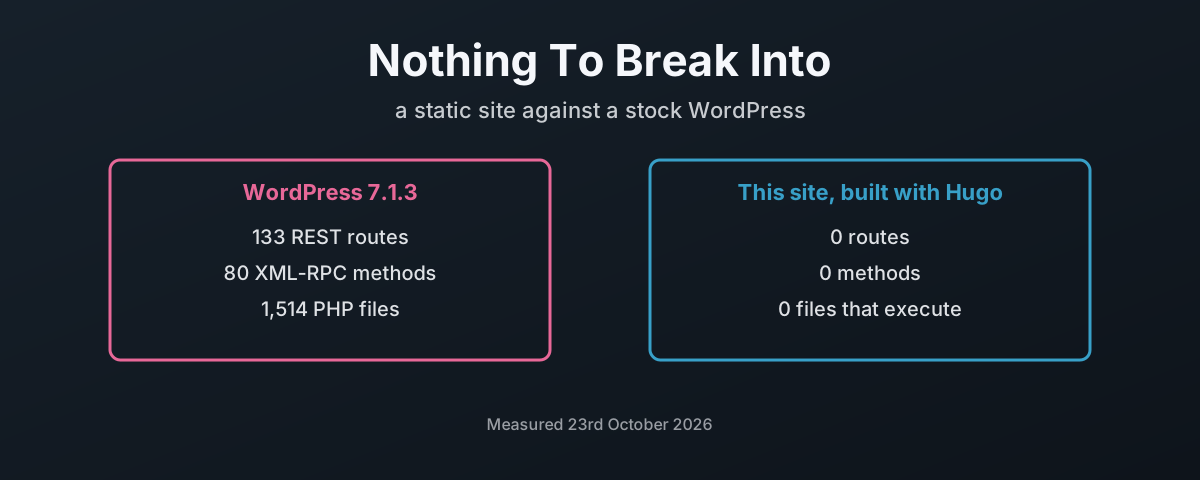
A stock WordPress exposes 133 REST routes, 80 XML-RPC methods and 1,514 PHP files; this static site runs nothing on request

A Static Site Has Nothing To Break Into

This blog is built with Hugo and served as 6,343 plain files, with no code of mine running on any request. Against it, a stock WordPress 7.1.3 measured in a podman lab: 133 REST routes, 62 of them accepting writes, 80 XML-RPC methods, 1,514 PHP files, every one of its 3,785 files writable by the web server’s own user, and a database account holding every privilege. This post counts both attack surfaces, explains what Hugo’s own security model does at build time, owns up to where the risk moves once nothing runs at serve time, including two gaps in how this site was built, one of them now fixed, and sets out how to build a static site offline, once, and upload nothing but the finished files.
23rd October 2026 · 17 min · 4046 words · Damien Dye
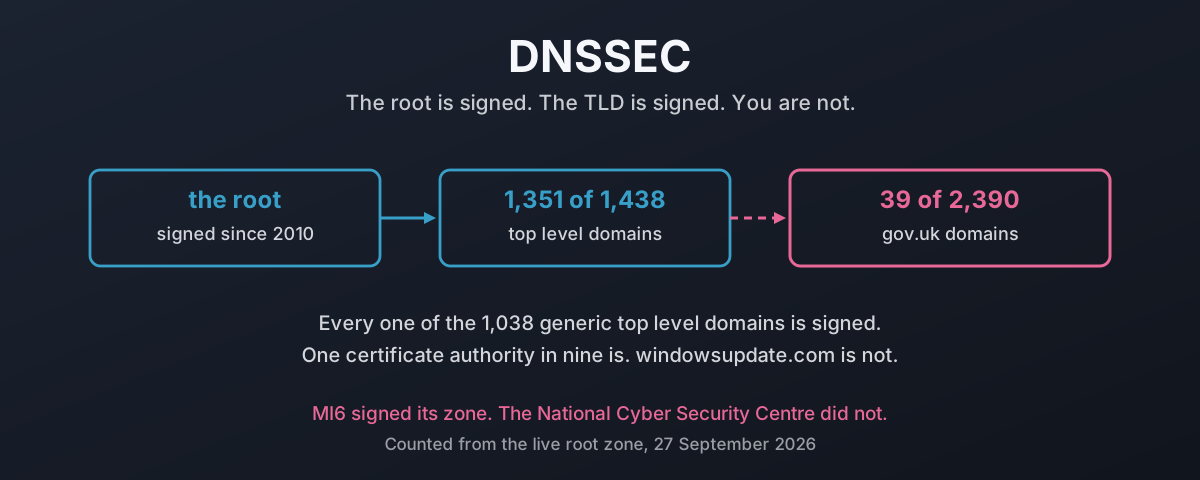
A chain of trust running from the signed root through a signed TLD and stopping at an unsigned second-level domain, with the counted figures beside each step

DNSSEC: Protecting Your Traffic From Forgery

The hard part of DNSSEC was finished years ago. Counted from the live root zone on 27th September 2026, 1,351 of 1,438 top level domains carry a DS record and every one of the 1,038 gTLDs is signed. Then it stops dead. A census of every gov.uk domain in the official register finds 39 signed out of 2,390 that still resolve, nine of them parish councils, while HMRC, the NHS, GCHQ and the National Cyber Security Centre are not among them. One certificate authority in nine has signed. So has one Linux or BSD distribution in five. windowsupdate.com has no DS at all. This is what a forged answer actually costs, what signing does about it, why the usual excuses do not survive contact with the numbers, and whether forty-two years after Mockapetris the real problem is that almost nobody understands what DNS actually promises.

27th September 2026 · 48 min · 10979 words · Damien Dye

What Your MSP Built You, And Who Else Can Reach It

Part 2 of 3. What actually gets built once the paperwork is signed: the box they will not be talked out of, the firewall that is the way in, the basics that were the thing you bought, and the agent on every machine that answers to somebody else’s console.

28th August 2026 · 39 min · 8266 words · Damien Dye

How Technology Became Something You Rent

Twenty years back you bought software and the copy was yours. Now you rent it, and the supplier sets the terms. Part 1 of 8 walks through how that happened, and why every step made it harder to go elsewhere.

25th August 2026 · 5 min · 875 words · Damien Dye

What Renting Your Technology Costs

Once moving supplier is hard, the costs change shape. The price follows your exit cost. Profit is declared in one country and earned in another. The law follows who owns the company, not where the building stands. Part 2 of 8, in plain language.

25th August 2026 · 7 min · 1386 words · Damien Dye

Who Pays for the Software You Use

The first 2 posts looked at what dependency costs you. This one looks at who else foots the bill: the volunteers keeping software going for very large companies, and the businesses bought, borrowed against and stripped back. Part 3 of 8, in plain language.

25th August 2026 · 9 min · 1754 words · Damien Dye

What the Record Shows

Picking a supplier means guessing how they will behave later. The fairest basis for that guess is what courts and regulators have already decided. Part 4 of 8 sets out the findings, includes the cases regulators lost, and draws the pattern.

25th August 2026 · 6 min · 1262 words · Damien Dye

How Far One Country's Law Reaches

Part 2 covered the law that reaches your data. Part 5 of 8 covers the law that reaches your company: large penalties under American law, a French parliamentary report on whether that works as a commercial weapon, trade pressure applied to tax law and to regulators, and products carrying one market’s assumptions everywhere.

25th August 2026 · 6 min · 1073 words · Damien Dye

Backdoors, and Who Gets Accused of Them

Shutting a supplier out on security grounds needs a standard, applied evenly. Part 6 of 8 sets out what has been established about weakened products and interception, including a Swiss parliamentary inquiry, and shows why a built-in way in belongs to whoever reaches it.

25th August 2026 · 6 min · 1099 words · Damien Dye

The Same Pattern in Other Industries

None of this is new, and it is not really about technology. Four companies control most of the world’s seed supply. Ten retailers move most of Britain’s food. Both produced a legal answer software has nowt like. Part 7 of 8 compares them, and asks why technology got away with it.

25th August 2026 · 5 min · 1007 words · Damien Dye