Skip to content
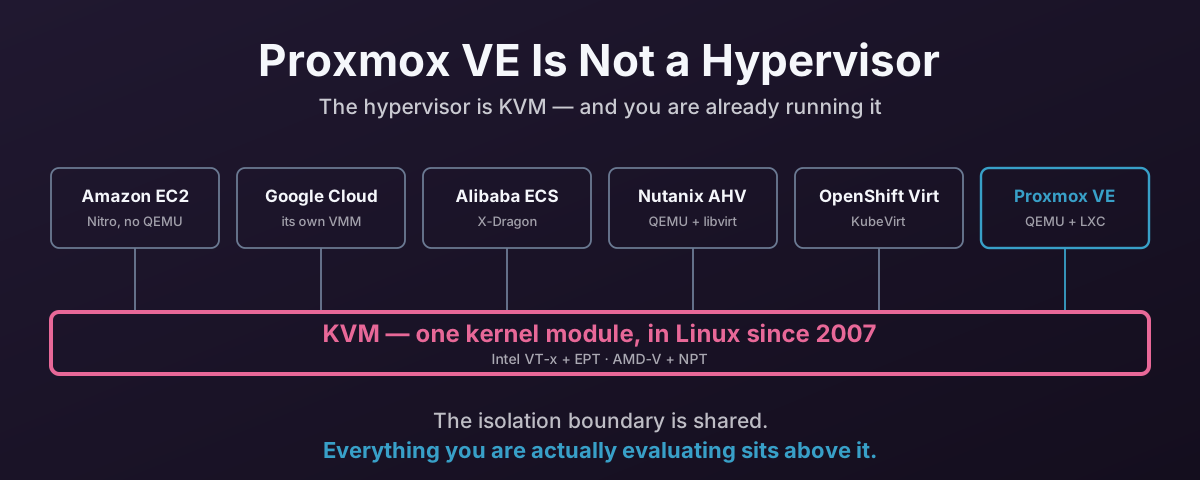
One KVM kernel module beneath five different management stacks

Proxmox VE Is Not a Hypervisor — KVM Is, and You Are Already Running It

“Is Proxmox enterprise grade?” is a question about the hypervisor, and Proxmox VE does not contain one. The hypervisor is KVM — the same kernel module underneath EC2, Google Cloud, Alibaba Cloud, Nutanix AHV and OpenShift Virtualisation. What Proxmox really maintains, why the type 1 argument is aimed at the wrong line, and what the shared foundation does not buy you.
12th August 2026 · 26 min · 5483 words · Damien Dye
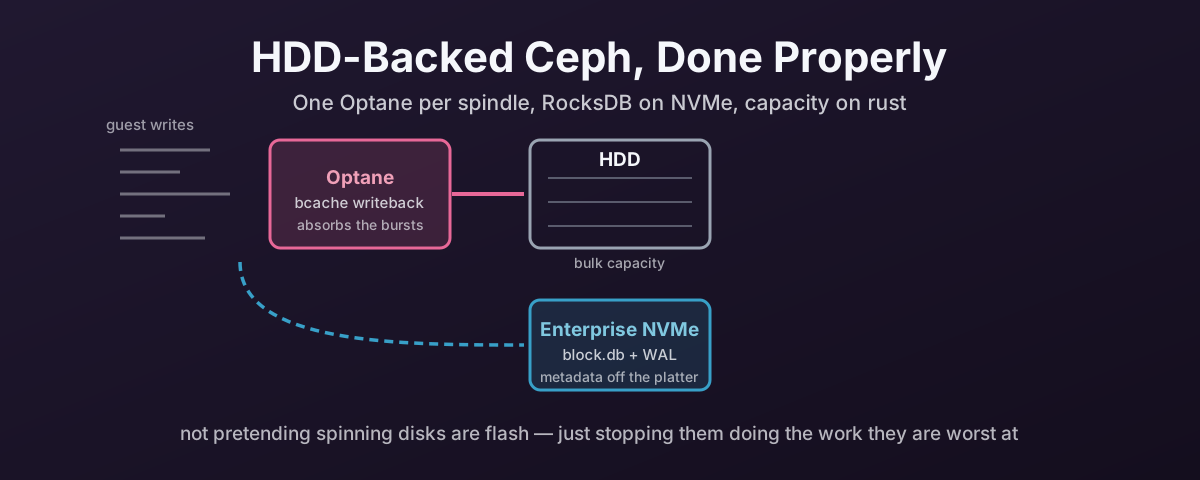
Three storage tiers: Optane absorbing writes, NVMe holding Ceph metadata, and HDDs providing bulk capacity

Making HDD-Backed Proxmox Ceph Clusters Fast — NVMe Metadata, One Optane Per Spindle, and What It Costs You

Flash pricing has made all-NVMe hard to justify, and enterprise HDDs are worth another look. Getting acceptable latency out of them on hyper-converged Proxmox Ceph means moving RocksDB off the spindle, pairing each disk with its own Optane through bcache — Optane specifically, because NAND endurance is wrong for that job — and being honest about the failure modes it buys you.

7th August 2026 · 35 min · 7359 words · Damien Dye
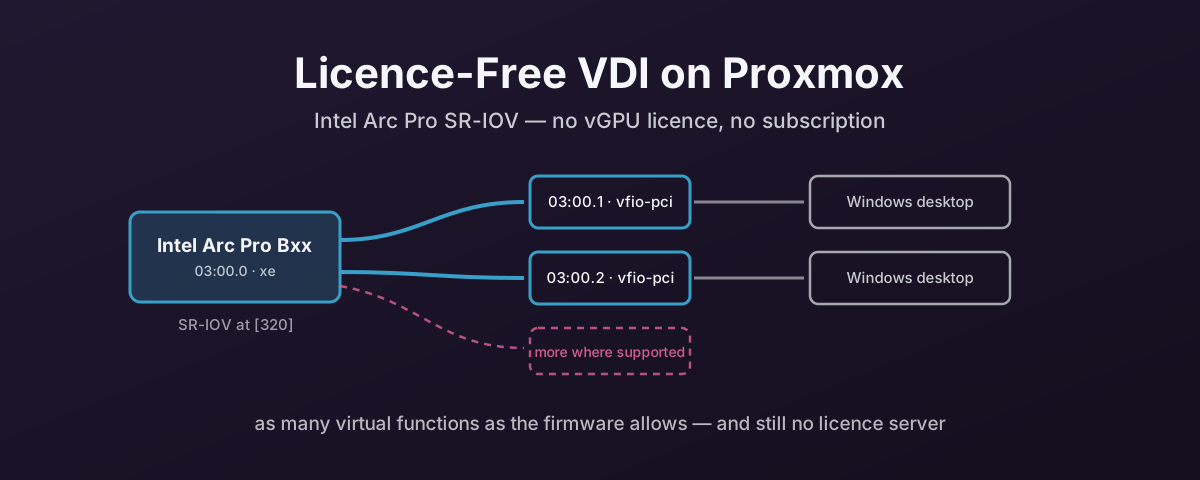
One physical GPU split into virtual functions handed to separate Windows desktops

Licence-Free Windows VDI on Proxmox with an Intel Arc Pro B50 — and the Firmware Limit That Stopped It

Intel’s Arc Pro cards do SR-IOV natively, with no vGPU licence to buy — which makes a licence-free Windows VDI on Proxmox genuinely possible. The whole build on a B50, the Windows-first bootstrap problem, why the firmware caps it at two virtual functions, and how many each card in the B-series gives you.

7th August 2026 · 16 min · 3385 words · Damien Dye
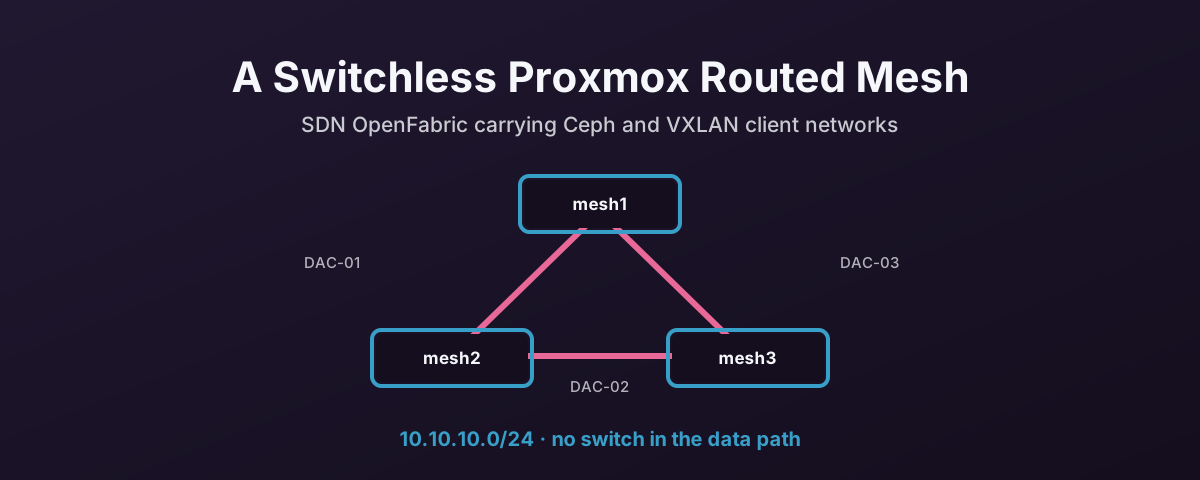
Three Proxmox nodes wired in a triangle mesh with direct cables and no switch

A Switchless Proxmox Mesh with SDN OpenFabric — Ceph and Client Networks Without a 100G Switch

Three Proxmox nodes wired directly to each other in a triangle, with OpenFabric routing over the mesh and Ceph plus VXLAN client networks riding on top. Built entirely in the web interface, and honest about where the design stops scaling.

7th August 2026 · 14 min · 2783 words · Damien Dye
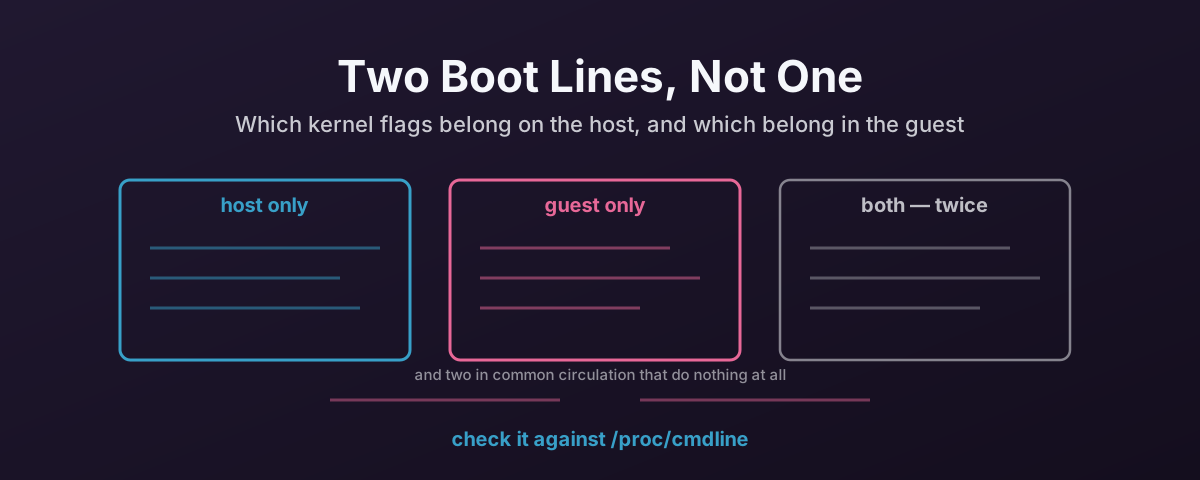
Kernel boot flags sorted into a host column and a guest column

Two Boot Lines — Which Kernel Flags Belong on a Proxmox Host, and Which Belong in the Guest

Most Proxmox tuning lines you find online are one blob of kernel flags. Half of them belong on the hypervisor, half belong inside the guest, two of the popular ones do nothing at all, and a few change meaning depending on which side of the boundary they land.

7th August 2026 · 14 min · 2953 words · Damien Dye
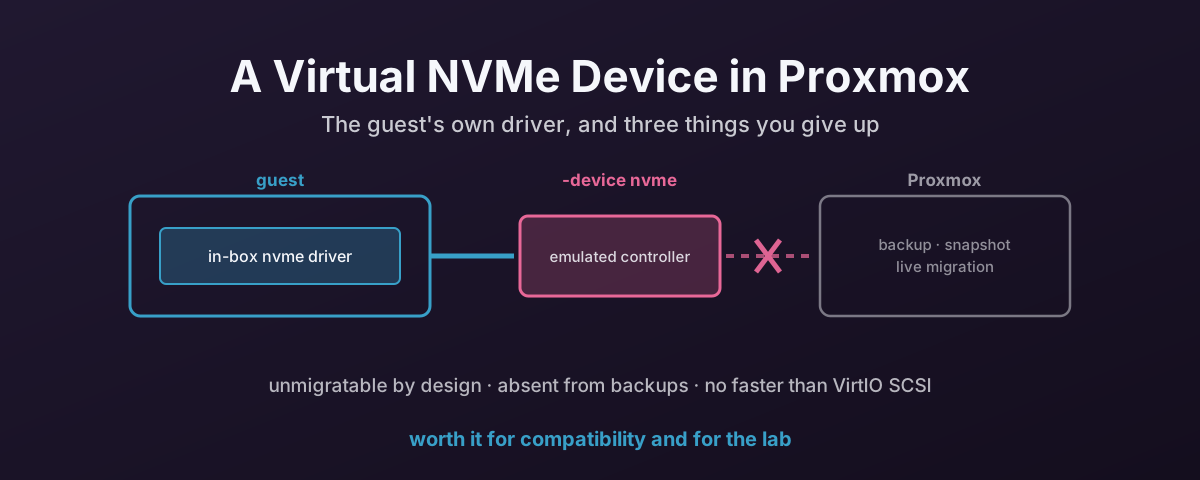
An emulated NVMe controller beside a VirtIO SCSI path, with Proxmox unable to see the former

A Virtual NVMe Device in Proxmox — and the Three Things You Give Up

QEMU can emulate a real NVMe controller, so the guest uses its own in-box NVMe driver with no VirtIO media required. It is also unmigratable by design, invisible to Proxmox backups, and no faster than VirtIO SCSI. Here is how to add one and when it is worth it.

7th August 2026 · 10 min · 2025 words · Damien Dye
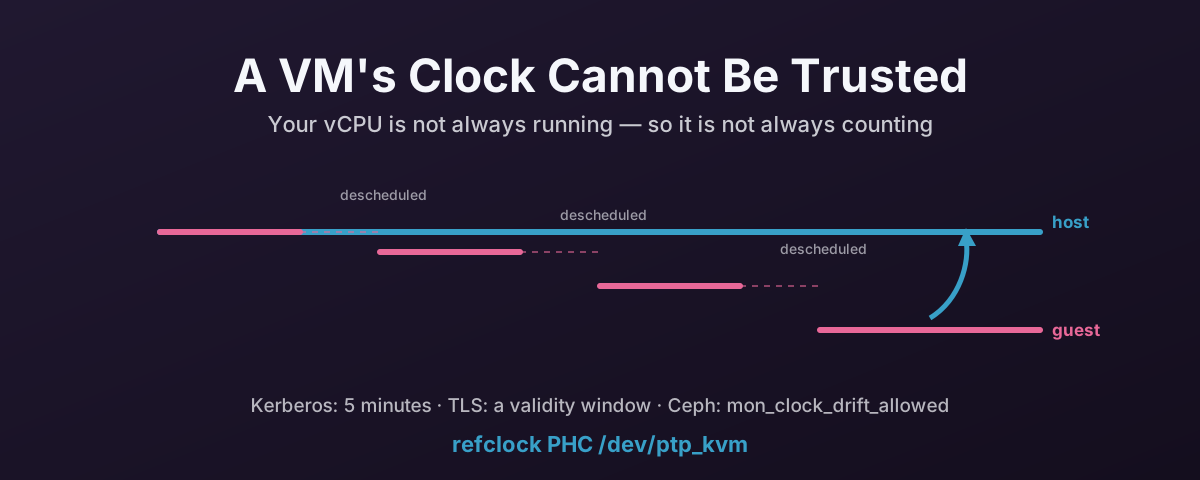
A guest clock drifting away from the host clock, and a hypercall pulling it back

A VM's Clock Cannot Be Trusted — and the ptp_kvm Fix for QEMU/KVM

A virtual machine’s clock is built on an assumption virtualisation breaks: that the CPU keeps counting. Why guest time drifts on every hypervisor, what the skew actually breaks — Kerberos, TLS, Ceph, Windows — and how ptp_kvm fixes it properly on QEMU/KVM.

7th August 2026 · 14 min · 2897 words · Damien Dye
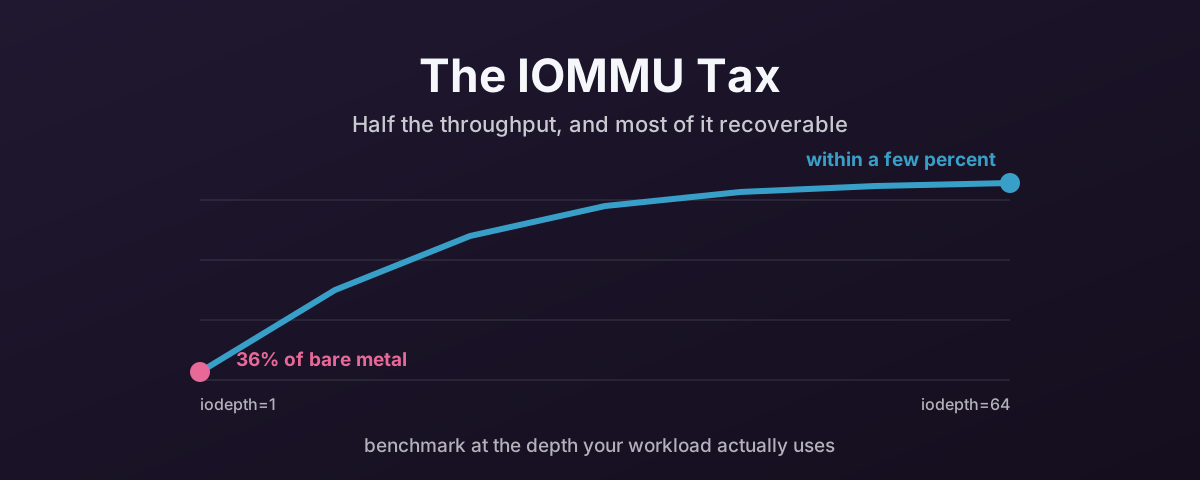
A curve rising from 36 percent of bare metal at queue depth 1 to within a few percent by queue depth 32

PCIe Passthrough Performance on Proxmox VE — The IOMMU Tax and How to Minimise It

Why PCIe devices lose throughput when passed through to a VM via VFIO, and the practical tuning steps that claw most of it back.

7th August 2026 · 19 min · 3994 words · Damien Dye
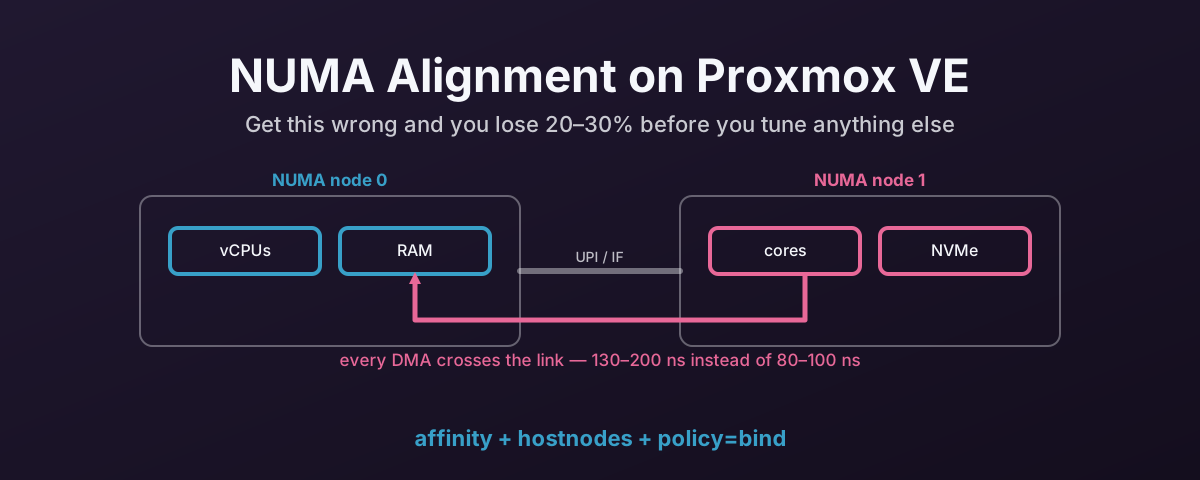
Two CPU sockets with a DMA path crossing the inter-socket link between them

NUMA Alignment on Proxmox VE — Why It Matters and How to Get It Right

On multi-socket systems, a VM with its vCPUs on one NUMA node and its passed-through device on another loses 20–30% throughput before you’ve even looked at anything else.

7th August 2026 · 9 min · 1758 words · Damien Dye
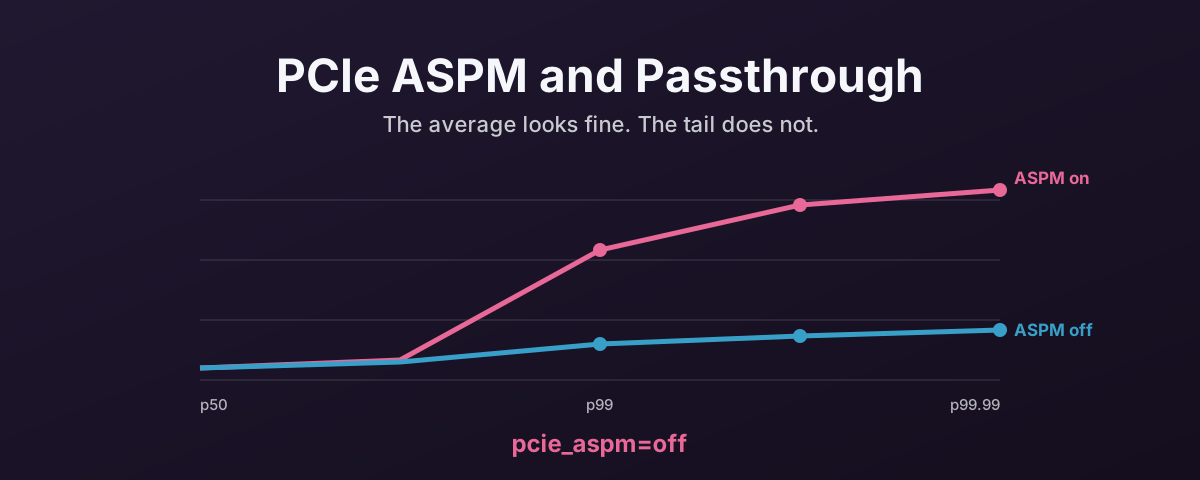
A latency-percentile curve that stays flat to p90 then climbs steeply, beside one that stays flat

PCIe ASPM and Why You Should Disable It for Passthrough

Active State Power Management saves a few watts on idle PCIe links. Under VFIO passthrough, it adds latency jitter that’s hard to diagnose and easy to fix.

7th August 2026 · 8 min · 1661 words · Damien Dye