Skip to content
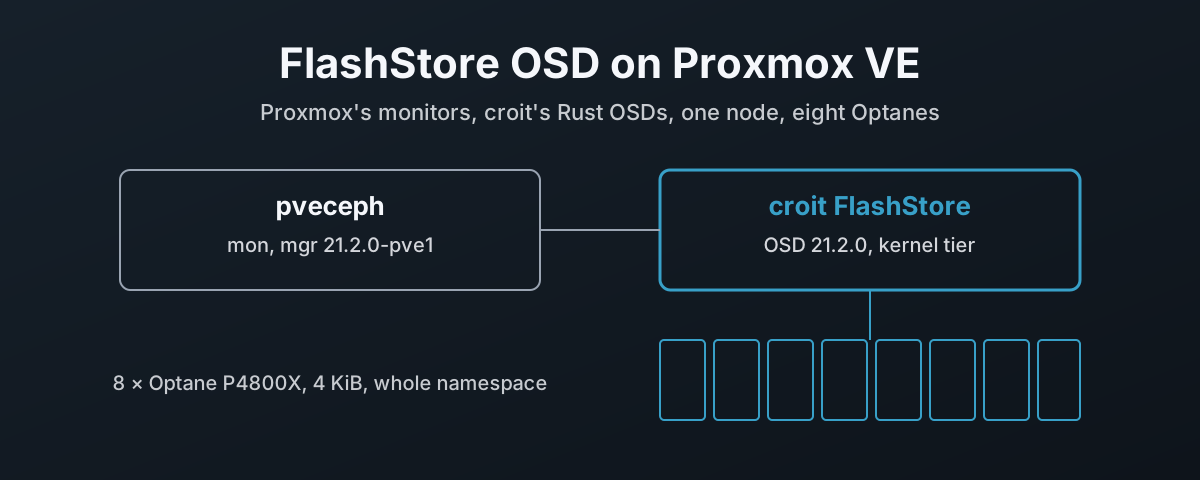
A Proxmox VE node running Proxmox's own Ceph monitor and manager beside croit FlashStore OSDs on eight Optane drives

FlashStore OSD on Proxmox VE: What It Took on One Node

croit’s FlashStore OSD is a Rust replacement for ceph-osd and BlueStore, in public preview since 9th November 2026. This deploys it hyperconverged on a single Proxmox VE 9.2 node: Ceph Umbrella 21.2.0 from the PVE wizard for the monitor and manager, FlashStore OSDs on Intel Optane P4800X drives. It covers why Umbrella is the only Proxmox release that matches, formatting the drives to 4 KiB and the controller reset that aborts a format, what croit-flashstore-osd –check reports, why the shipped unit cannot read Proxmox’s ceph.conf and the drop-in that fixes it, the NVMe passthrough Proxmox’s kernel refuses and the direct backend that works, preparing OSDs by PCI address, what the PVE OSD panel makes of them, a pool, RBD storage and a Fisher-Price OS (Windows) VM installed onto it, CrystalDiskMark from inside that VM read against the drives’ own counters, Ceph’s memory with all eight OSDs active, three VMs at once on a 1 GiB memory target, and a setup script that does all of it, tested by rebuilding an OSD from nothing.
11th November 2026 · 35 min · 7721 words · Damien Dye
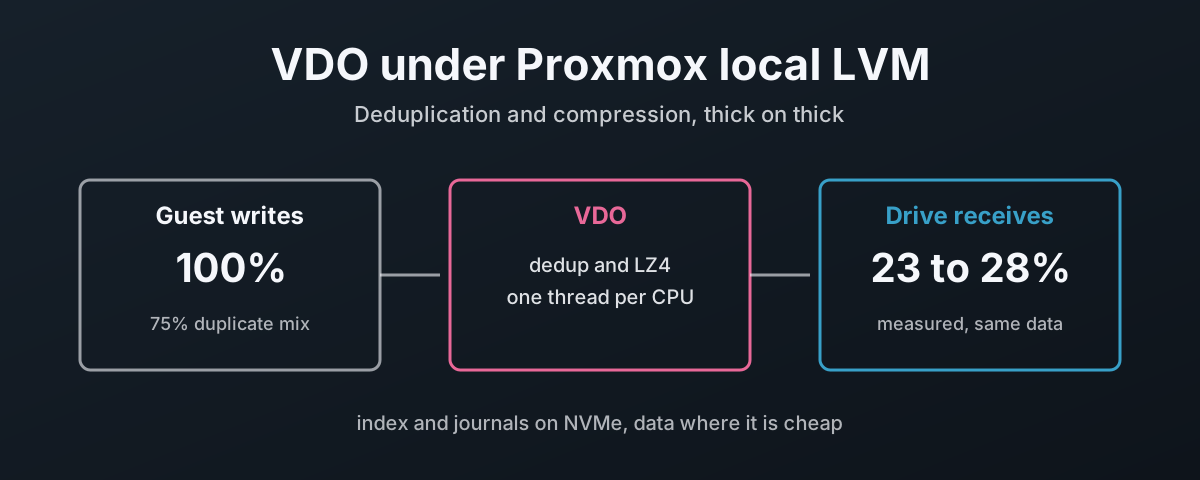
Guest writes on the left, VDO in the middle, and only about a quarter of the bytes reaching the drive on the right

VDO Under Proxmox Local LVM: Fewer Bytes Reach the Drive

VDO is the kernel’s deduplication and compression layer. Under a thick LVM volume group it gives Proxmox VE local disks that write one copy of every block the VMs share, so far fewer bytes ever reach the drive. This builds it thick on thick on a Proxmox VE 9 host, with VDO sized to the space it really has so nothing above it can overcommit, the lvm.conf scan_lvs setting and its filter, and VDO’s threads matched to the CPU count. It measures what deduplication saved on a template and six full clones, two ISOs, zeros and random data, how many bytes the drive actually received against what the guest wrote, and what VDO costs against the same Intel Optane with no VDO at all. It then builds the pool with VDO’s index and journals on NVMe and the data on a second device, proves the layout with vdolistmetadata, measures how the I/O splits, then puts VDO on top of bcache with one NVMe partitioned between the bcache cache and VDO’s metadata, and measures how many bytes reach the cache with and without VDO. It reasons through what all of this means on HDD hardware RAID6, and covers discard on delete.

27th October 2026 · 28 min · 6177 words · Damien Dye
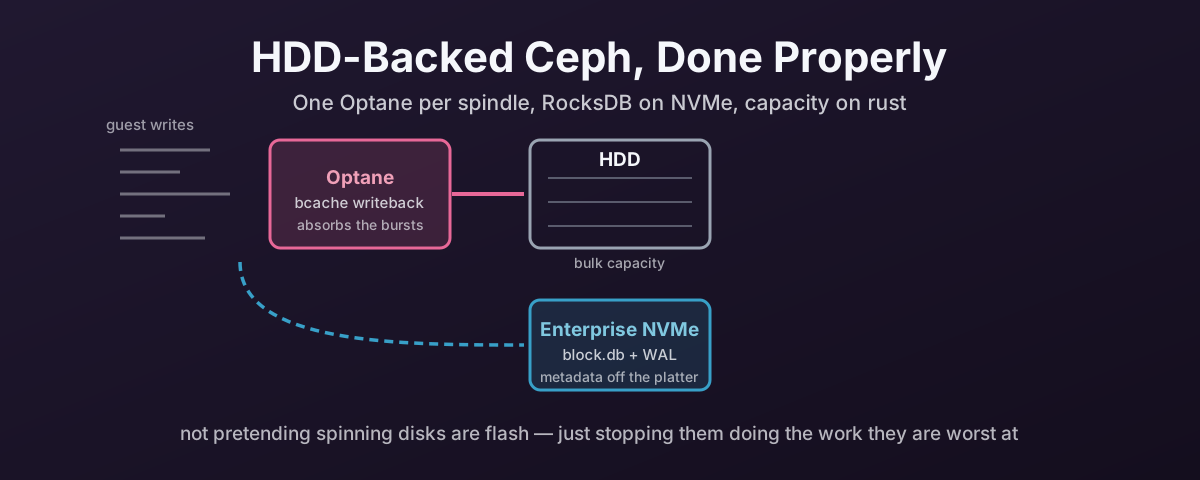
Three storage tiers: Optane absorbing writes, NVMe holding Ceph metadata, and HDDs providing bulk capacity

Making HDD-Backed Proxmox Ceph Clusters Fast — NVMe Metadata, One Optane Per Spindle, and What It Costs You

Flash pricing has made all-NVMe hard to justify, and enterprise HDDs are worth another look. Getting acceptable latency out of them on hyper-converged Proxmox Ceph means moving RocksDB off the spindle, pairing each disk with its own Optane through bcache — Optane specifically, because NAND endurance is wrong for that job — and being honest about the failure modes it buys you.

7th August 2026 · 35 min · 7359 words · Damien Dye