Skip to content
Two Proxmox defaults: Hyper-V enlightenments switched on by the VM's OS Type, and CPU microcode switched on by how the host was installed

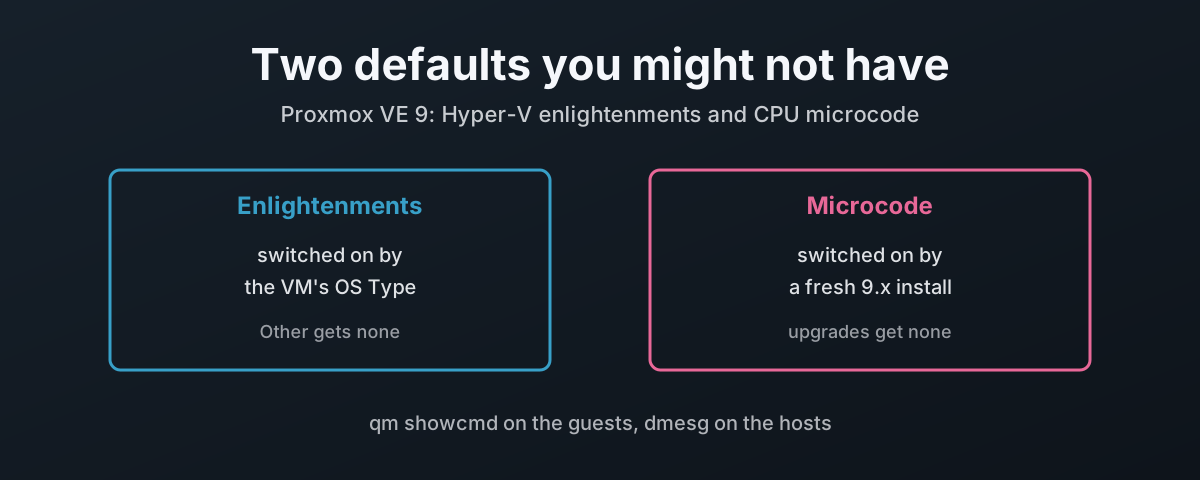
Two Proxmox VE 9 Defaults You Might Not Have: Hyper-V Enlightenments and CPU Microcode

Proxmox VE 9 turns on Hyper-V enlightenments for Fisher-Price OS (Windows) guests and installs CPU microcode on new hosts, but only if the VM was given a Microsoft Windows OS type and the host came from the 9.x installer. This covers what the enlightenments do, the exact rules qemu-server uses to pick them (measured on a live 9.2 host), why machine version pinning keeps older VMs off the July 2026 hv-evmcs fix, the pve-qemu-kvm build that fix needs and what each QEMU release since 10.0 fixed for those guests, why they belong on q35 and never i440fx (which the wizard still hands most of them), the two flags you can set by hand, how to prove what a VM is running, where microcode comes from (board firmware, Debian and Proxmox’s own repository), why an upgraded host has none (with an Intel node four Intel releases behind as the example), the initramfs rebuild that installing it triggers and the older kernels that rebuild misses, the Zen 5 RDSEED failure that follows, enabling it, a rolling reboot across a Ceph cluster, and rolling back a bad update.
27th October 2026 · 25 min · 6016 words · Damien Dye
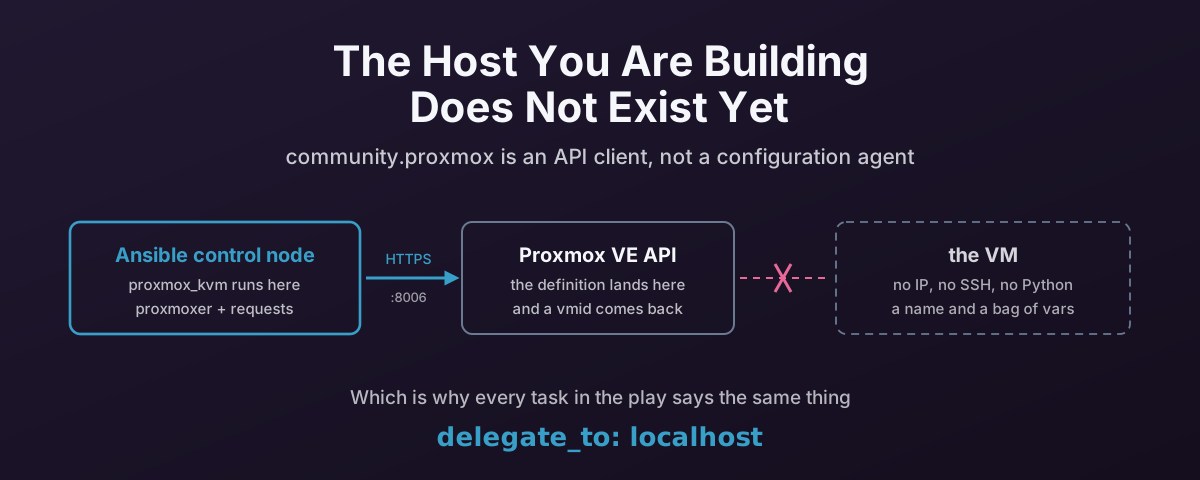
An Ansible control node calling the Proxmox API, with the VM being built having no connection back

Creating Proxmox VMs with Ansible — The Host You Are Building Does Not Exist Yet

The community.proxmox collection is an API client, not a configuration agent, and that changes the shape of every playbook that uses it. Where the tasks actually run, why proxmox_kvm declines to converge rather than updating, why proxmox_disk and proxmox_nic are where disk and NIC changes belong, and the undocumented return value you will end up needing.

12th August 2026 · 25 min · 5224 words · Damien Dye
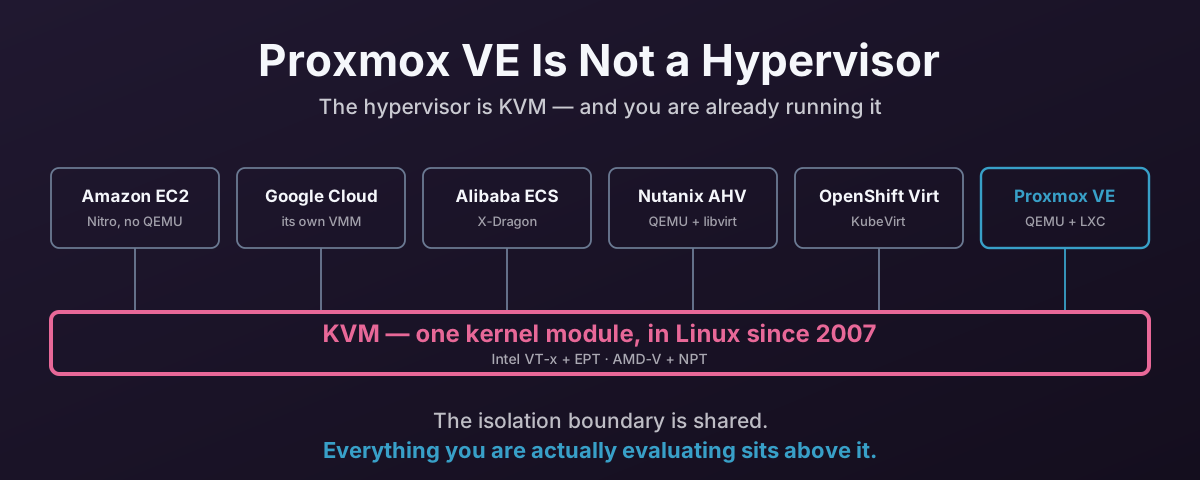
One KVM kernel module beneath five different management stacks

Proxmox VE Is Not a Hypervisor — KVM Is, and You Are Already Running It

“Is Proxmox enterprise grade?” is a question about the hypervisor, and Proxmox VE does not contain one. The hypervisor is KVM — the same kernel module underneath EC2, Google Cloud, Alibaba Cloud, Nutanix AHV and OpenShift Virtualisation. What Proxmox really maintains, why the type 1 argument is aimed at the wrong line, and what the shared foundation does not buy you.

12th August 2026 · 26 min · 5483 words · Damien Dye
Kernel boot flags sorted into a host column and a guest column

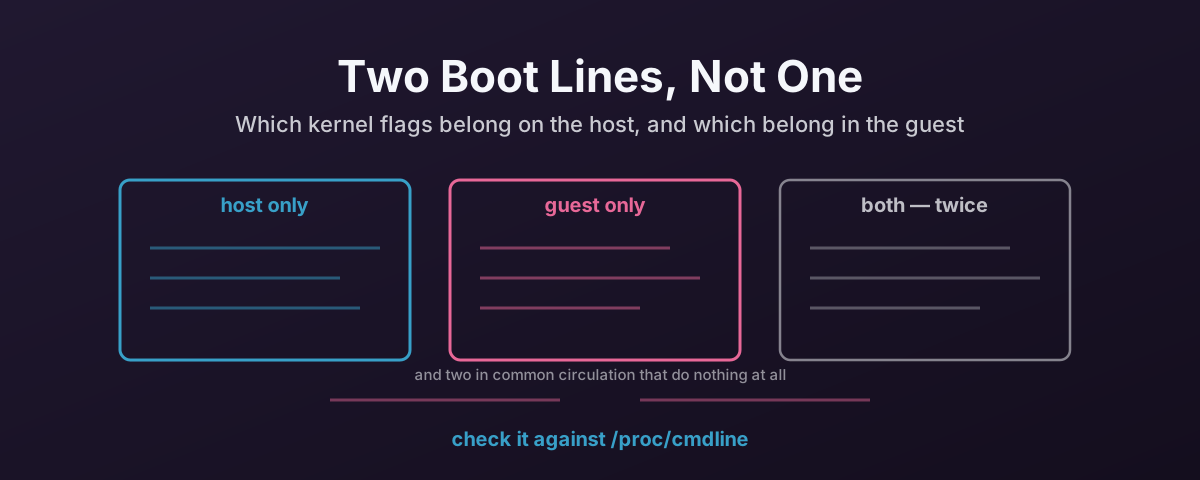
Two Boot Lines — Which Kernel Flags Belong on a Proxmox Host, and Which Belong in the Guest

Most Proxmox tuning lines you find online are one blob of kernel flags. Half of them belong on the hypervisor, half belong inside the guest, two of the popular ones do nothing at all, and a few change meaning depending on which side of the boundary they land.

7th August 2026 · 14 min · 2953 words · Damien Dye
An emulated NVMe controller beside a VirtIO SCSI path, with Proxmox unable to see the former

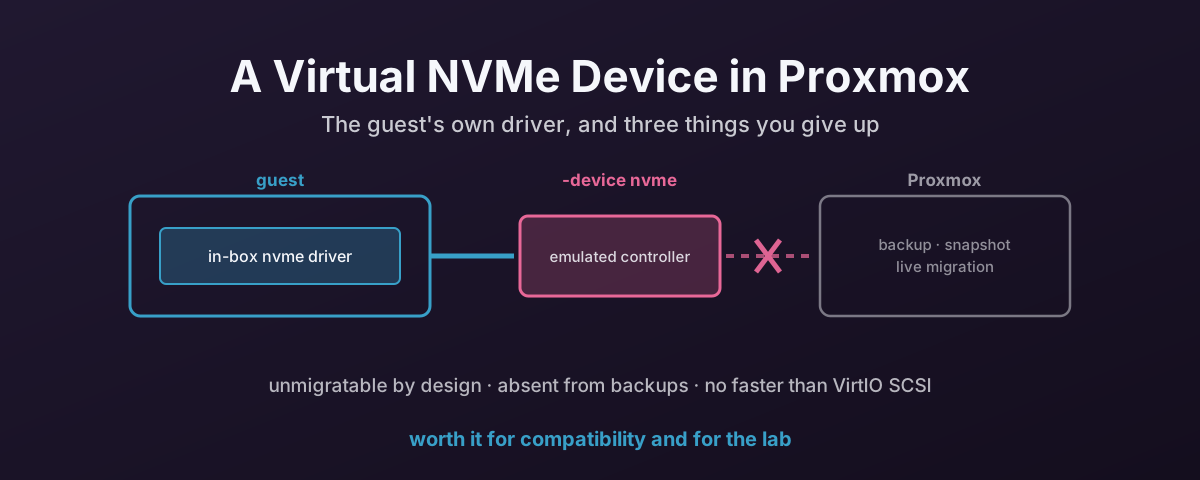
A Virtual NVMe Device in Proxmox — and the Three Things You Give Up

QEMU can emulate a real NVMe controller, so the guest uses its own in-box NVMe driver with no VirtIO media required. It is also unmigratable by design, invisible to Proxmox backups, and no faster than VirtIO SCSI. Here is how to add one and when it is worth it.

7th August 2026 · 10 min · 2025 words · Damien Dye
A guest clock drifting away from the host clock, and a hypercall pulling it back

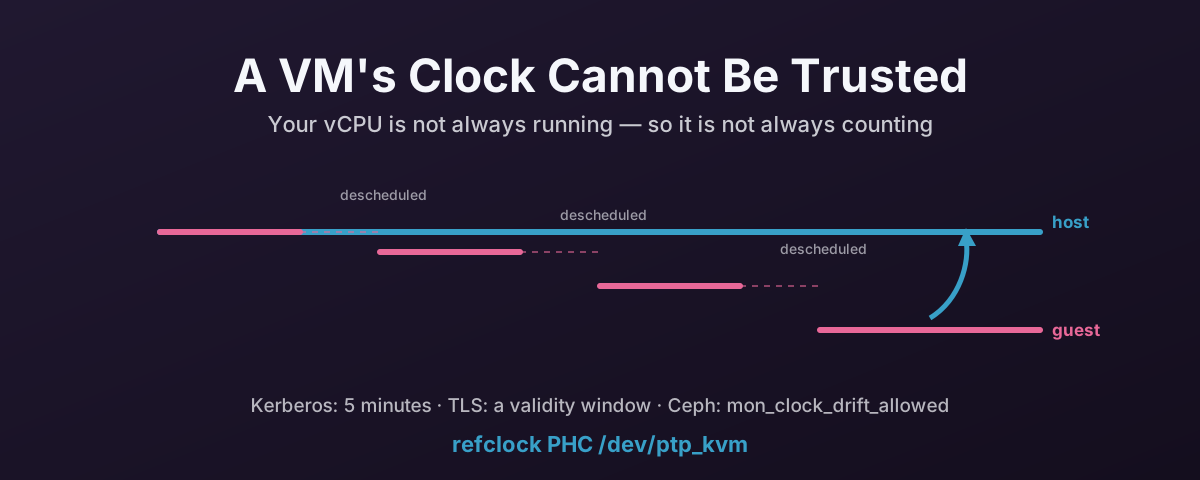
A VM's Clock Cannot Be Trusted — and the ptp_kvm Fix for QEMU/KVM

A virtual machine’s clock is built on an assumption virtualisation breaks: that the CPU keeps counting. Why guest time drifts on every hypervisor, what the skew actually breaks — Kerberos, TLS, Ceph, Windows — and how ptp_kvm fixes it properly on QEMU/KVM.

7th August 2026 · 14 min · 2897 words · Damien Dye