Skip to content
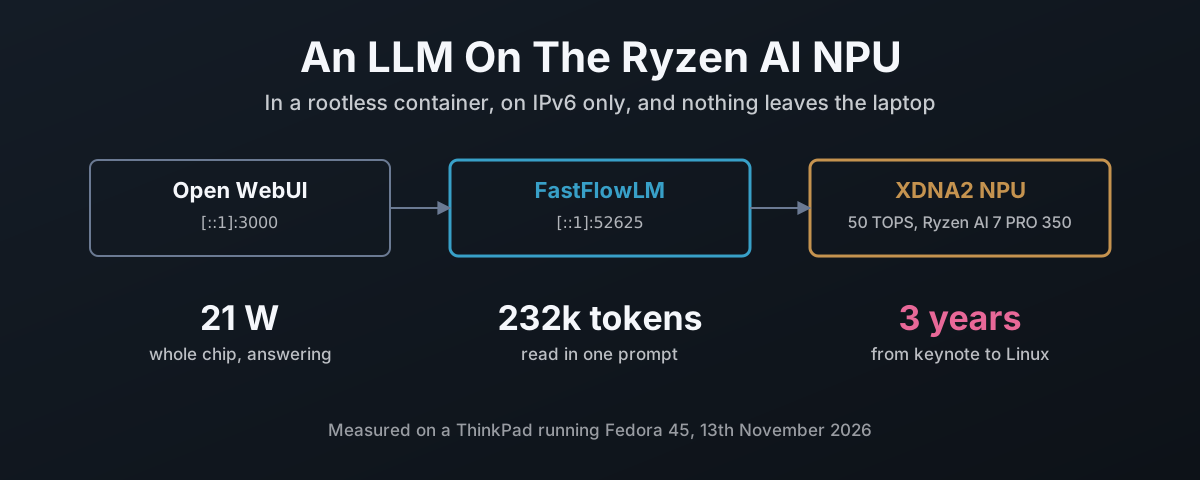
Open WebUI to FastFlowLM to the XDNA2 NPU on IPv6 loopback: 21 W answering, 232,000 tokens in one prompt, three years from AMD's keynote to Linux

Running An LLM On The Ryzen AI NPU, In A Container

The NPU in a Ryzen AI laptop is 50 TOPS that sits idle on most Linux installs. This walks through building AMD’s amdxdna driver and keeping only the kernel module on the host, building FastFlowLM with AMD’s XRT runtime into a rootless podman container matched to that driver, binding everything to IPv6 loopback and starting it at boot with Quadlet. Then what it does: nine models benchmarked, a 232,000-token context test, Whisper speech-to-text at ten times real time, Open WebUI and the 7,000 hidden tokens it was adding to every message, and the speed and energy of the NPU measured against llama.cpp on the Radeon 860M iGPU. Last, the timeline: three years from AMD announcing Ryzen AI to a language model on its NPU under Linux, delivered by a project AMD did not start, while the effort went to Copilot+ on the Fisher-Price OS (Windows) instead of the data centre and the Linux tooling AI professionals actually use.
13th November 2026 · 24 min · 5853 words · Damien Dye
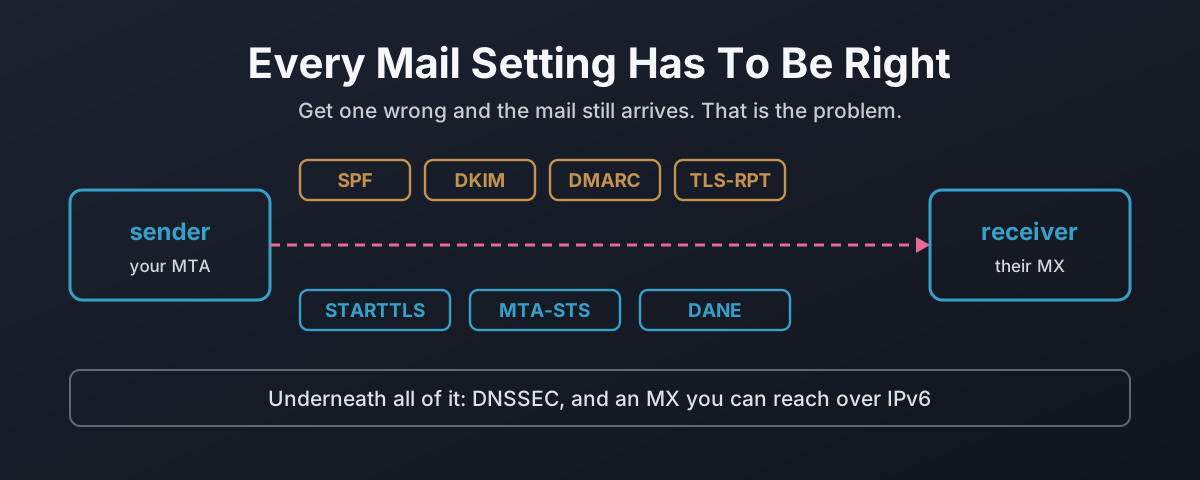
Seven mail settings along the path between two servers, with DNSSEC and IPv6 underneath

Why Every Mail Setting Has To Be Right

Every layer of email security is designed to fall back to working rather than fail safely. Strip the STARTTLS line out of a greeting and an opportunistic sender carries on in the clear, which RFC 3207 both describes as an attack and, on a public server, forbids you to defend against. This post captures that man-in-the-middle in a lab, then walks the seven settings that protect a message in transit, showing for each one what it protects, what it does not, and how it fails open when it is wrong. From there to DANE: why a TLSA record is worthless without DNSSEC under it, why 3 1 1 and key reuse matter, and how a stale record is the one failure that closes rather than opens. Then a read-only census of UK banks, the big mail providers and the certificate authorities, counting how many actually do any of it.

22nd October 2026 · 20 min · 4350 words · Damien Dye
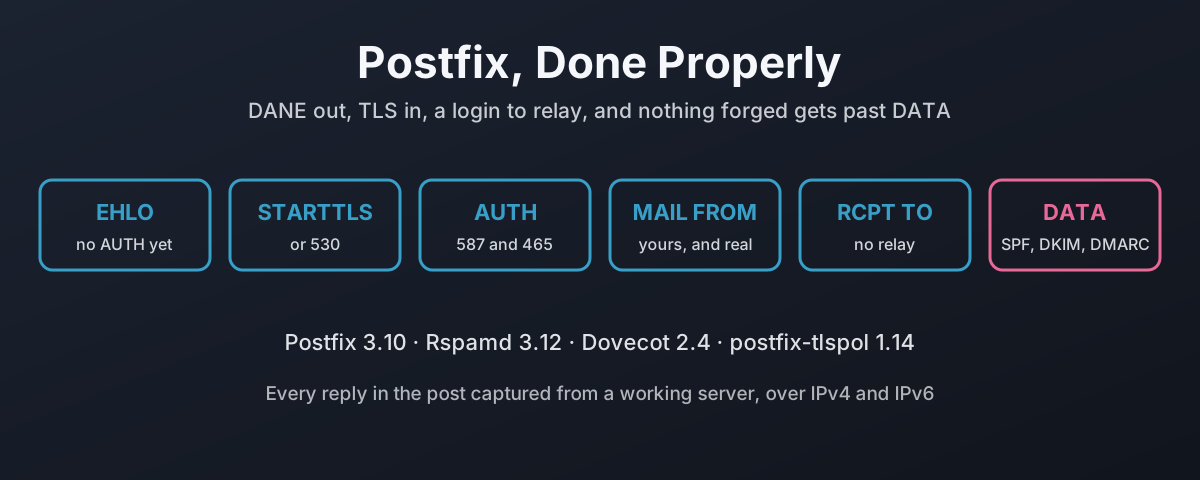
An SMTP session as six stages, each with the rule that rejects there

Postfix, DANE And Every Setting Done Properly

Out of the box Postfix sends in the clear when the far end offers no TLS and takes mail from anybody claiming to be anybody. This is the other build: Postfix 3.10.13 with Dovecot for logins, Rspamd for SPF, DKIM and DMARC, and postfix-tlspol for DANE and MTA-STS. No plaintext in or out, port 25 never relays, a login owns its addresses in the envelope and the From header, sender domains that do not exist are refused, and a tampered or spoofed message never gets past DATA. Every reply was captured in a lab over IPv4 and IPv6, along with the six settings that silently do nothing until something else is set too, the certbot default that breaks DANE on renewal, and what all of it costs you in forwarded mail.

22nd October 2026 · 22 min · 4858 words · Damien Dye
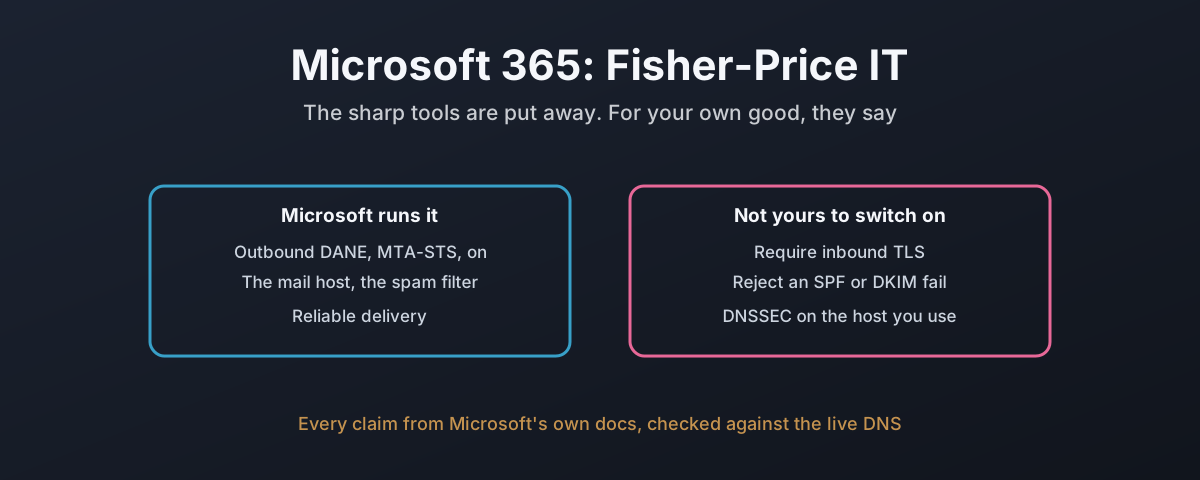
A split between the settings Microsoft 365 controls for you and the few you are left to configure, with the rules it cannot meet marked

Microsoft 365: The Fisher-Price IT Edition

Most organisations do not run their own mail server. They pay Microsoft, and Exchange Online does the work. So this post holds Microsoft 365 to exactly the house rules the Postfix and Stalwart builds met, using nothing but Microsoft’s own documentation and read-only DNS against real tenants. Some of the rules it meets well: outbound DANE and MTA-STS are on by default, and inbound DANE with DNSSEC finally went GA. Several it cannot meet at all. There is no documented way to require inbound TLS from every sender, no way to reject an SPF hard fail at the door, nothing that rejects on a failed DKIM signature alone, and no control that drops mail from a sender domain that does not exist. DNSSEC is explicitly not planned for the mail host every tenant actually uses. The IPv6 rollout that was meant to take six months has left the NCSC’s own mailbox unreachable over IPv6 two years on. And the documentation contradicts itself on wildcards, on SPF, and on DNSSEC. This is the platform most of the country’s mail runs on, and this is what it will and will not let you do.

22nd October 2026 · 12 min · 2800 words · Damien Dye
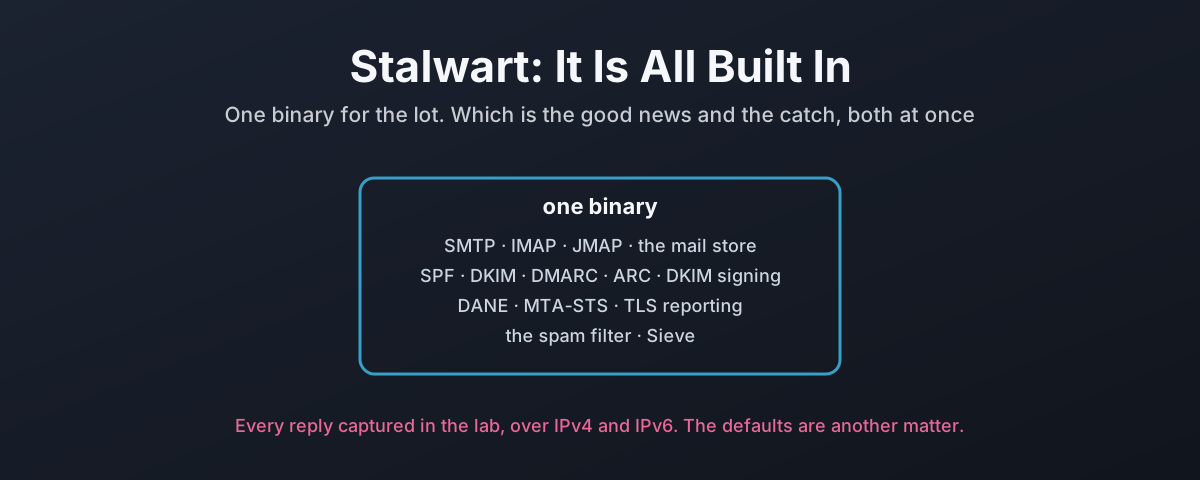
Stalwart as one binary containing the whole mail stack, against the four-package Postfix build

Stalwart: DANE And The Rest, Built In

Stalwart is a whole mail server in one binary: SMTP and IMAP and JMAP, SPF, DKIM, DMARC, ARC, DANE, MTA-STS, TLS reporting, a spam filter and the mail store, with no milter to wire up and no policy daemon to run beside it. This post holds it to the same house rules as the Postfix build and captures every reply in the lab. The rules all go on, but the story is in the detail: the settings live in a database rather than a file, the defaults as shipped accept plaintext and a tampered invoice, each rule lands in a different one of four configuration mechanisms, DKIM-fail rejection needs a Sieve script because the built-in check reports a tampered body as neutral, the unknown-sender check runs only after the whole message is in and fails open on a DNS error, and the MTA-STS sender bounces on the first attempt where the standard says it should defer. Built in is genuinely less to wire together. It is not the same as safe by default.

22nd October 2026 · 12 min · 2654 words · Damien Dye
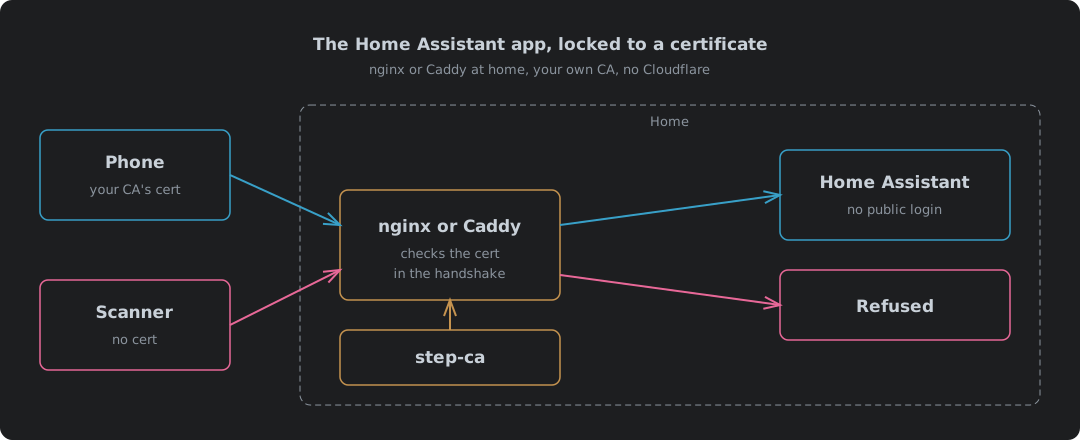
A phone holding a certificate from your own CA passes nginx or Caddy at home and reaches Home Assistant, while a scanner without one is refused in the handshake

The Home Assistant App Locked To A Certificate, With nginx Or Caddy And No Cloudflare

Locking the Home Assistant app to a client certificate with nginx or Caddy at home, with step-ca as the certificate authority instead of Cloudflare. What changes when Cloudflare leaves the path, an nginx config and a Caddy config each tested with no certificate, a good one, a revoked one and a WebSocket upgrade over IPv4 and IPv6, why nginx can check a CRL and Caddy can only keep an allowlist, the Home Assistant trusted-proxy settings, what the phone needs installed, and where it falls down.

9th October 2026 · 10 min · 2147 words · Damien Dye

A VPN Out of Parts: PPP, Tap Devices and Netcat

A VPN is two jobs: something that makes a virtual link, and something that carries the bytes. PPP has done the first since 1994 and does not care what the second is — which is why PPTP, L2TP and every dial-up line you ever used are the same protocol over different carriers. Netcat is a carrier. This builds it both ways. First pppd: the pty option and what it does with a pseudo-terminal, the TCP version everyone tries first, why running a stream protocol inside TCP melts under loss, the UDP version that is the one to use, the async HDLC framing and the ACCM that decides how much bandwidth goes on escaping control characters, addressing and routing and IPV6CP, and keeping the link up when the carrier dies without telling you. Then the same tunnel with no PPP at all — a tap device, one datagram per frame over UDP, the length prefix you have to invent yourself over TCP, tun against tap, and bridging. Then the part netcat has no answer for: wrapping the carrier in TLS with ncat, stunnel and openssl, and in DTLS with socat, which is the shape you actually want. It is never really the right tool, and that is the point: it shows how egress behaves once an attacker has root inside your network and outbound access was not blocked by default, and why default-deny at the border is the only control that was ever real.

14th September 2026 · 60 min · 13157 words · Damien Dye

Your Firewall Takes Instructions From Strangers. Turn Off the Protocol Helpers.

A protocol helper — SIP ALG, FTP helper, H.323 ALG, conntrack helper, call it what your vendor calls it — reads the payload of a connection, finds an address and a port written in the text, and opens an inbound pinhole for them. It cannot tell whether that text came from a real FTP client or from a hidden form on a web page, because there is nothing in it to tell. Samy Kamkar proved the browser case in 2010. NAT Slipstreaming proved it again in 2020, and Armis extended it in 2021 to reach any device on your network, not just the machine that clicked. The IETF asked for these off by default in 2007, Linux turned them off in 2016, and the browser vendors ended up shipping a blocked-port list that reads like a directory of conntrack modules. This post walks the mechanism diagram by diagram — the expectation table, the segment-alignment trick, H.323 call forwarding, the IRC helper that fires on somebody else’s message — takes in the IPsec pass-through helper, which cannot read ESP at all and steers inbound packets on an SPI it watched go past in the clear, sets the lot against the Cyber Essentials firewall control it plainly fails, and gives the commands to turn it all off on Linux, Cisco, Juniper, FortiGate and MikroTik.

14th September 2026 · 54 min · 12564 words · Damien Dye

IPsec Was a Good Idea. It Is Time to Turn It Off.

IPsec was right in 1995: encrypt below the application, bind the security association to the IP address, let every protocol inherit it. Then NAT arrived, carrier-grade NAT finished the job, and the fix was to wrap the whole thing in UDP and keep a timer running so a translation table would not forget you. This post shows how it falls down, diagram by diagram — the security association that cannot survive a rewritten header, the two translators every CGNAT line now has, the NAT64 standard that names IPsec as out of scope, the tunnel that cannot use a second link because ESP has no ports, the MTU nobody owns, and L2TP and PPTP as the two protocols that were never fit to be here. It carries the vendor documentation from Cisco, Juniper and Microsoft that admits every one of those, the eighteen pieces that call themselves an IPsec VPN including the two that were never standards at all, why the Fisher-Price OS has never truly interoperated with an open stack, a working method for diagnosing IPsec while you still run it, and the case for retiring the lot with dates.

13th September 2026 · 68 min · 16979 words · Damien Dye

Ping: The Diagnostic Tool That Opens a Whole Lot More

Ping, not the rest of ICMP, is the liability: echo is a channel every host must answer with your own bytes, so a network that ‘only allows ping’ already has a full VPN out. This walks the threat first — what it costs your egress, and how a visitor on your WiFi or an unlocked ethernet port can open one — then three working tunnels built on ping alone (Hans, icmptunnel, and a short Python one with AES-128), the MTU and IPv6 catches, and the rule that shuts it: drop echo, keep the errors, in nftables, pf, Cisco, Junos, MikroTik and Windows.

1st September 2026 · 36 min · 7657 words · Damien Dye