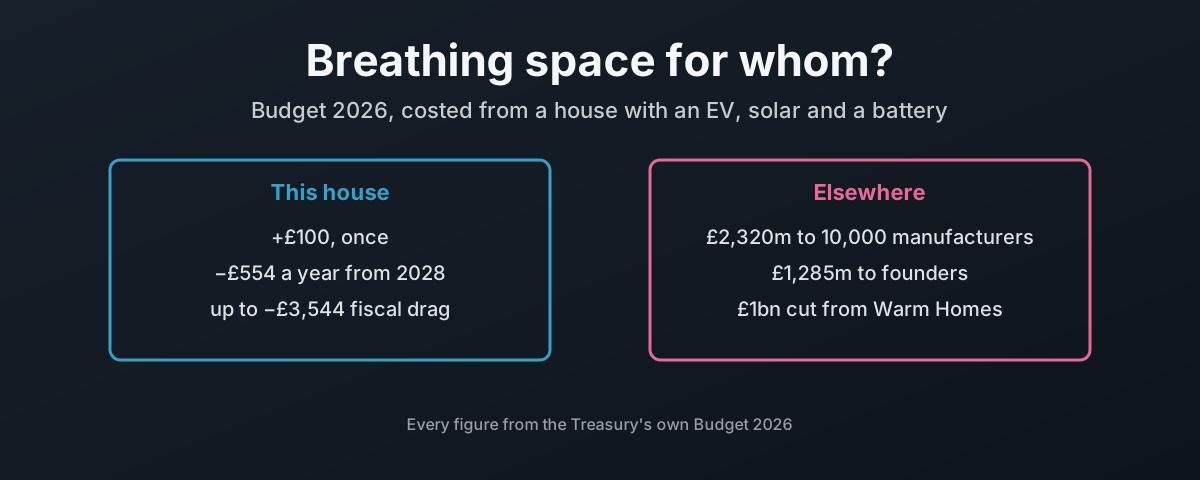
Breathing Space For Whom? The 2026 Budget From A House With An EV, Solar And A Battery
What the 2026 Budget actually does for a 40% taxpayer who works from home, runs an EV doing 20,000 miles a year on the other half’s commute, runs solar and a battery, and has cut gas to hot water and a little heating. A measure-by-measure ledger from the Treasury’s own document: the £100 Household Energy Payment, 0% VAT on electricity, the gas standing charge moving into the unit rate while the larger electricity standing charge stays, the Gas Shipper Obligation moved off the gas bill and onto general taxation, and who it pays, why hydrogen made from electricity loses to a 280% heat pump, the eVED mileage charge on a 20,000-mile commute, and the fiscal drag of thresholds frozen from 2021 to 2031, worked out against where the law would have put them, for a 40% taxpayer and for the low paid it hits first. Then who gets the money instead, from the Budget’s own costings: 10,000 energy-intensive manufacturers, energy-from-waste operators, high-growth founders against ordinary owners selling up, small high-street firms paid for by small online sellers, data centres at the front of the grid queue, and the defence build-up funded partly by cutting the Warm Homes Plan, with the MoD’s own figures on how much goes to BAE Systems and how much is spent without competition. What it does not do for insulation and rooftop solar, where VAT goes back up to 5%, and what has happened to the heat pump grant. And what the new online marketplace VAT rule means for selling your own things on eBay.