Skip to content
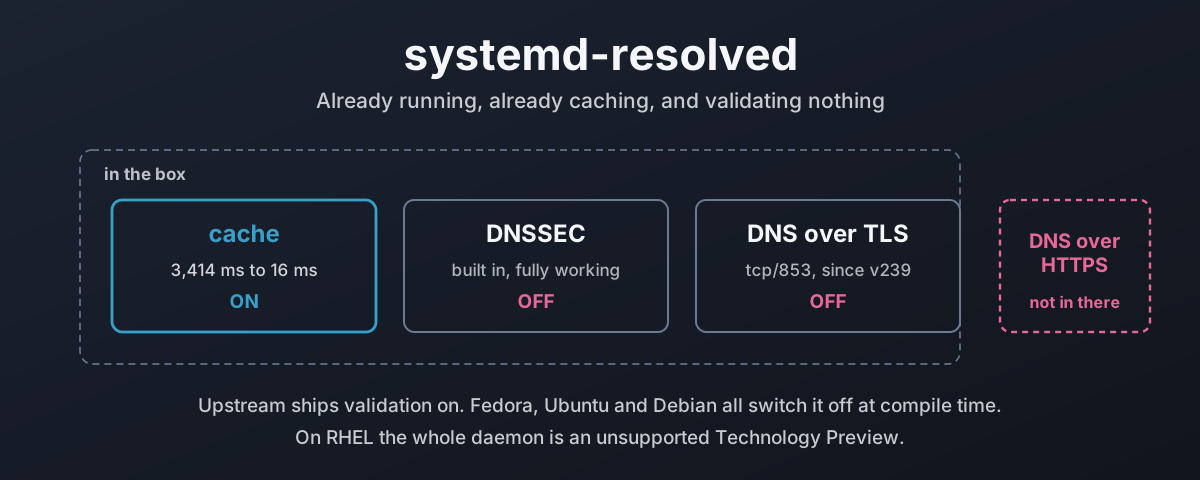
A name lookup passing through systemd-resolved's stub listener into a cache, a validator and an encrypted transport, with the validator and the encryption switched off

Resolved: The Resolver You Are Already Running

systemd-resolved is running on most Linux desktops right now, caching every lookup and validating none of them. This walks the resolution path from nss-resolve to the two stub listeners, measures what the cache is worth on a real machine, turns DNSSEC on and shows the three verdicts it can return, and explains why validation is off by default when upstream ships it on. Then a census of how little of the web is actually signed, DNS over TLS and its strict-versus-opportunistic trap, and the DNS over HTTPS support that has been requested since 2018 and still does not exist. Ends with what Fedora, Ubuntu, Debian and the RHEL family each ship, how to wire it into each one, and why the features your distro disabled are defaults rather than missing code.

27th September 2026 Â· 38 min Â· 8443 words Â· Damien Dye

Webex Is Looking For Your Certificates On A Cisco Build Server

Webex 46.8.0.35631 on Fedora 44 sits behind a yellow banner reading “Offline - No internet connection” while every other program on the machine reaches the internet without complaint. It stopped the VoIP line dead. The network was never the problem: Cisco bundle their own fork of OpenSSL and built it with OPENSSLDIR set to /workspace/.conan2/p/b/cisco8ee8b59cf93de/p/ssl, a directory that exists on a build container and nowhere else, so it loads no trust anchors and every handshake fails. The post runs in order: what the broken state actually is, asking the shipped library where it thinks its certificates live, reproducing the exact error code outside Webex, why nothing warns you, the two fixes that do not work and why, and the one that does. Then the build process: they used $ORIGIN for the code and left three data paths absolute, the RPM header names a container ID so the container was already in the pipeline and never used to run the result, the package requires a glibc from 2018 because they will not link statically, 2.2 GB is shipped twice, and it carries no documentation and no file marked as configuration. Then how it should have been built, the six fixes and the one-line check that catches it. And finally the cross-check: Cisco hold 98 entries in CISA’s known-exploited catalogue, second only to Microsoft, and a trust path nobody checked and a bypass nobody checked are the same failure at different stakes.

15th September 2026 Â· 42 min Â· 9141 words Â· Damien Dye