Skip to content
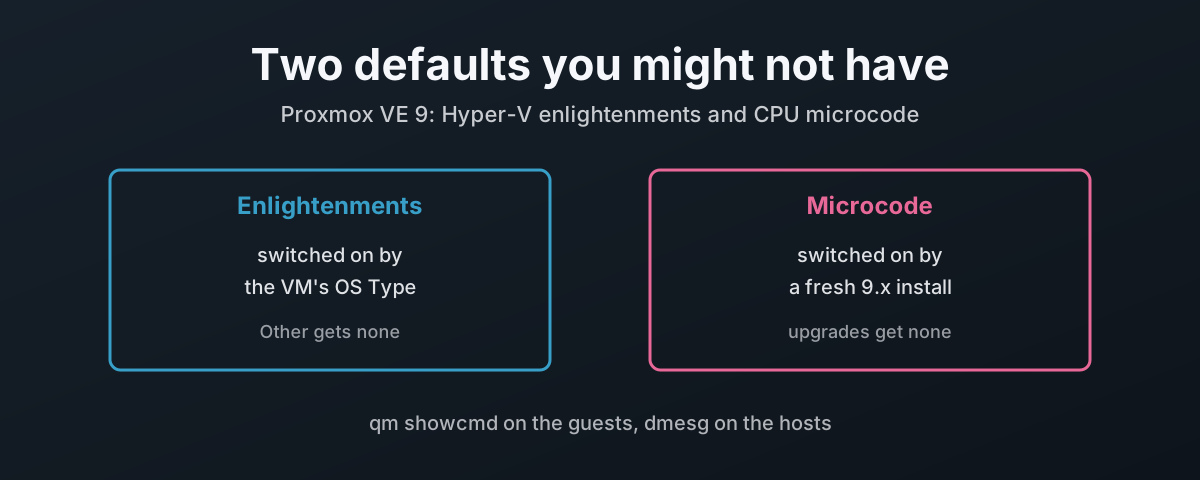
Two Proxmox defaults: Hyper-V enlightenments switched on by the VM's OS Type, and CPU microcode switched on by how the host was installed

Two Proxmox VE 9 Defaults You Might Not Have: Hyper-V Enlightenments and CPU Microcode

Proxmox VE 9 turns on Hyper-V enlightenments for Fisher-Price OS (Windows) guests and installs CPU microcode on new hosts, but only if the VM was given a Microsoft Windows OS type and the host came from the 9.x installer. This covers what the enlightenments do, the exact rules qemu-server uses to pick them (measured on a live 9.2 host), why machine version pinning keeps older VMs off the July 2026 hv-evmcs fix, the pve-qemu-kvm build that fix needs and what each QEMU release since 10.0 fixed for those guests, why they belong on q35 and never i440fx (which the wizard still hands most of them), the two flags you can set by hand, how to prove what a VM is running, where microcode comes from (board firmware, Debian and Proxmox’s own repository), why an upgraded host has none (with an Intel node four Intel releases behind as the example), the initramfs rebuild that installing it triggers and the older kernels that rebuild misses, the Zen 5 RDSEED failure that follows, enabling it, a rolling reboot across a Ceph cluster, and rolling back a bad update.
27th October 2026 · 25 min · 6016 words · Damien Dye
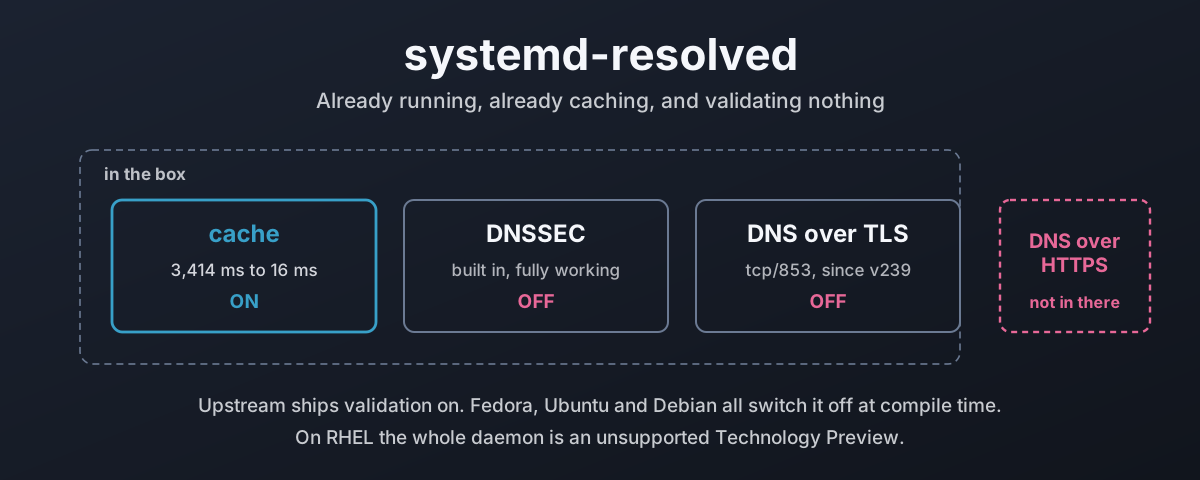
A name lookup passing through systemd-resolved's stub listener into a cache, a validator and an encrypted transport, with the validator and the encryption switched off

Resolved: The Resolver You Are Already Running

systemd-resolved is running on most Linux desktops right now, caching every lookup and validating none of them. This walks the resolution path from nss-resolve to the two stub listeners, measures what the cache is worth on a real machine, turns DNSSEC on and shows the three verdicts it can return, and explains why validation is off by default when upstream ships it on. Then a census of how little of the web is actually signed, DNS over TLS and its strict-versus-opportunistic trap, and the DNS over HTTPS support that has been requested since 2018 and still does not exist. Ends with what Fedora, Ubuntu, Debian and the RHEL family each ship, how to wire it into each one, and why the features your distro disabled are defaults rather than missing code.

27th September 2026 · 38 min · 8443 words · Damien Dye