Skip to content
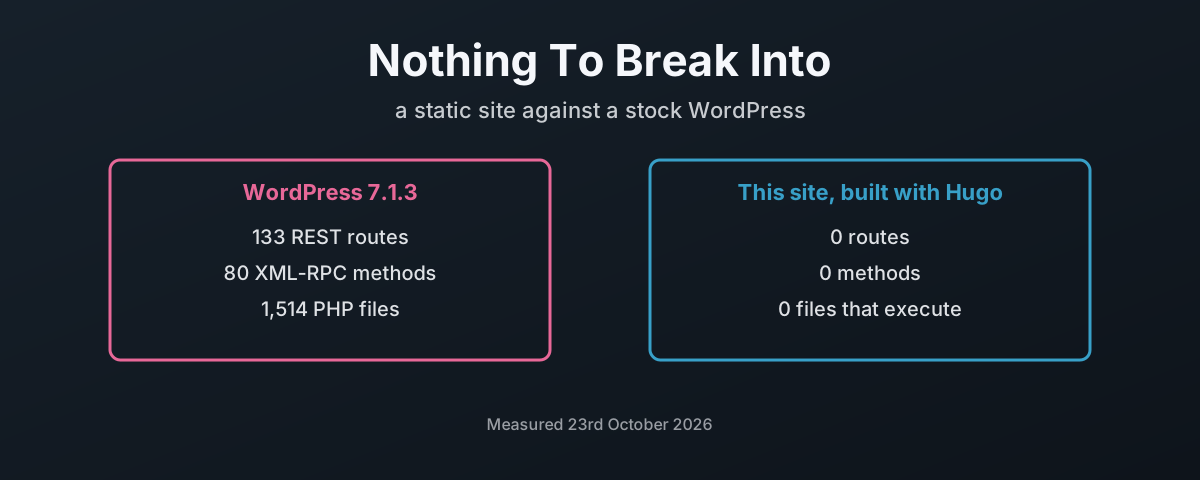
A stock WordPress exposes 133 REST routes, 80 XML-RPC methods and 1,514 PHP files; this static site runs nothing on request

A Static Site Has Nothing To Break Into

This blog is built with Hugo and served as 6,343 plain files, with no code of mine running on any request. Against it, a stock WordPress 7.1.3 measured in a podman lab: 133 REST routes, 62 of them accepting writes, 80 XML-RPC methods, 1,514 PHP files, every one of its 3,785 files writable by the web server’s own user, and a database account holding every privilege. This post counts both attack surfaces, explains what Hugo’s own security model does at build time, owns up to where the risk moves once nothing runs at serve time, including two gaps in how this site was built, one of them now fixed, and sets out how to build a static site offline, once, and upload nothing but the finished files.
23rd October 2026 · 17 min · 4046 words · Damien Dye
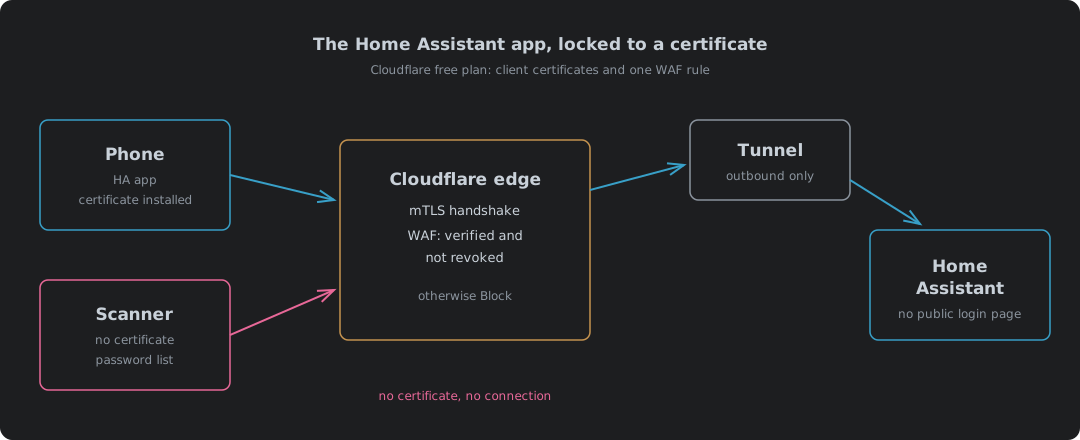
A phone holding a client certificate passes Cloudflare's edge check and reaches Home Assistant through a tunnel, while a scanner without one is blocked at the edge

The Home Assistant App Over Cloudflare, Locked To A Certificate, On The Free Plan

Reaching Home Assistant from the Android app away from home without putting a login page on the internet. How the remote-access options compare on exposure, real cost (machine load and DDoS as well as the bill), blocking risk and battery, why Cloudflare Access and service tokens do not suit the app, how the free-plan client certificates and a WAF custom rule lock a tunnel hostname to the phones that hold a certificate, which Home Assistant settings the reverse proxy needs, building the PKCS12 file, putting a Let’s Encrypt certificate on the origin and why renewal needs a restart, what the scanners did in the first two hours, and what the phone, Chrome, Helium and the Companion app’s two clients each did with the certificate. A self-hosted nginx or Caddy version is a separate post.

9th October 2026 · 19 min · 4709 words · Damien Dye
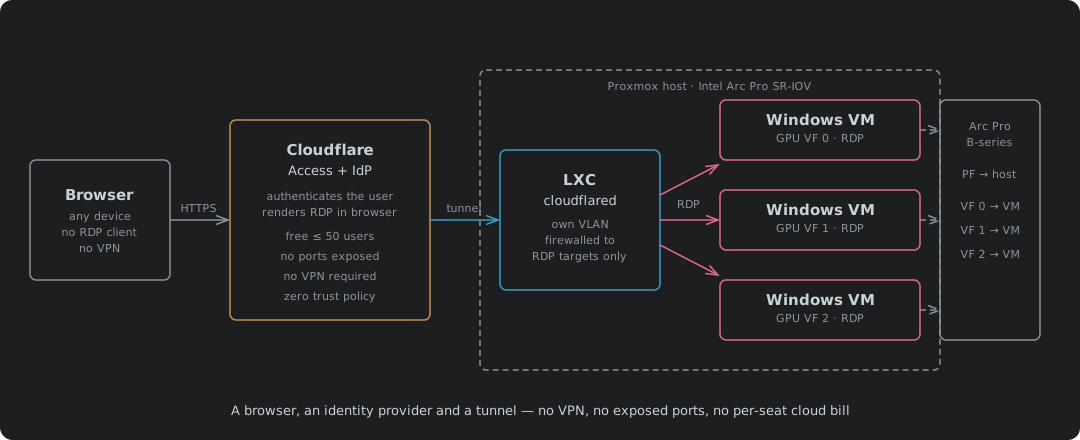
A browser connecting through Cloudflare Access to Windows VMs on a Proxmox host with Intel Arc Pro GPU virtual functions

Zero Trust VDI Without the Cloud Bill — Proxmox, Intel Arc Pro and Cloudflare Access

Part one: the architecture and the cost argument for replacing Azure Virtual Desktop with Proxmox, Intel Arc Pro SR-IOV and Cloudflare Access. On-prem OAuth for identity, browser-rendered RDP, a firewalled LXC tunnel on its own VLAN, KSM for memory density, and profiles on Ceph. The next post builds it.

2nd September 2026 · 17 min · 3677 words · Damien Dye