Skip to content
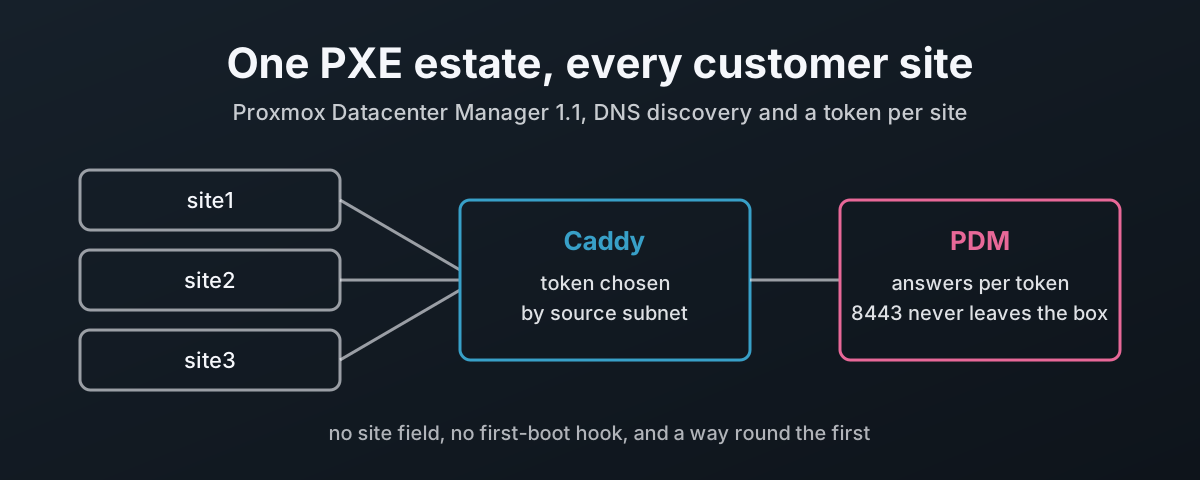
Three customer sites feeding one Caddy, which hands each its own token, in front of one Proxmox Datacenter Manager

One PXE Estate for Every Customer: Unattended Installs with Proxmox Datacenter Manager

Proxmox Datacenter Manager 1.1 can serve answer files to the Proxmox automated installer, which makes it a natural install server for an MSP looking after many customer sites. The use case is a customer who wanted every site built with its own naming, root password and SSH keys, by plugging a server into the right VLAN and booting it, with no serial numbers to collect and no answer file per machine; this post covers that booting and installing half, and leaves joining the cluster aside. It cannot match an answer on the site, and it cannot give a node a first-boot script, and both are shown from PDM’s own source. This builds one PXE estate for every site anyway: one boot image carrying a non-secret catch token, DNS TXT discovery so the image holds no URL, and a Caddy proxy that swaps the catch token for the site’s own bearer token by source subnet. It covers how PDM picks an answer, prepare-iso for iPXE, the DNS records, dnsmasq and the iPXE loop, a hardened Caddy that serves the whole PDM UI on 443 with 8443 closed by nftables, logging which token was used by name only, the post-installation webhook, adding Proxmox Backup Server, and the trade-offs that remain.
7th November 2026 · 35 min · 8070 words · Damien Dye

NetBox: What It Holds, And How To Make It Hold Yours

A hands-on walk through NetBox 4.7.2 with an estate loaded into it rather than an empty demo. What each screen holds and what you do with it: rack elevations, cable traces, the IPAM tree, dual-stack interfaces, and the cabinet that turns out to be 90.7 per cent full of power while only 28.6 per cent full of kit. How to stand one up as a container stack and on a host from the packages, both run end to end. The order you have to fill it in, derived from which foreign keys are actually mandatory. How one install is carved into customers so another customer’s device returns 404 and an ungranted object type returns 403. Config contexts and the inheritance that makes them worth more than custom fields. Adding your own values to NetBox’s own status menus. Three ways to add the object your business runs on, including a datastore modelled with no code. How to write validation rules and validator classes so the database refuses what your house standard forbids. And the story of the 2021 fork that produced Nautobot, what it was for, and what has since converged. Plus driving the whole thing from the netbox.netbox Ansible collection, where the inventory is a query rather than a file and one module argument quietly allocates a new address every time it runs.

30th September 2026 · 53 min · 11614 words · Damien Dye
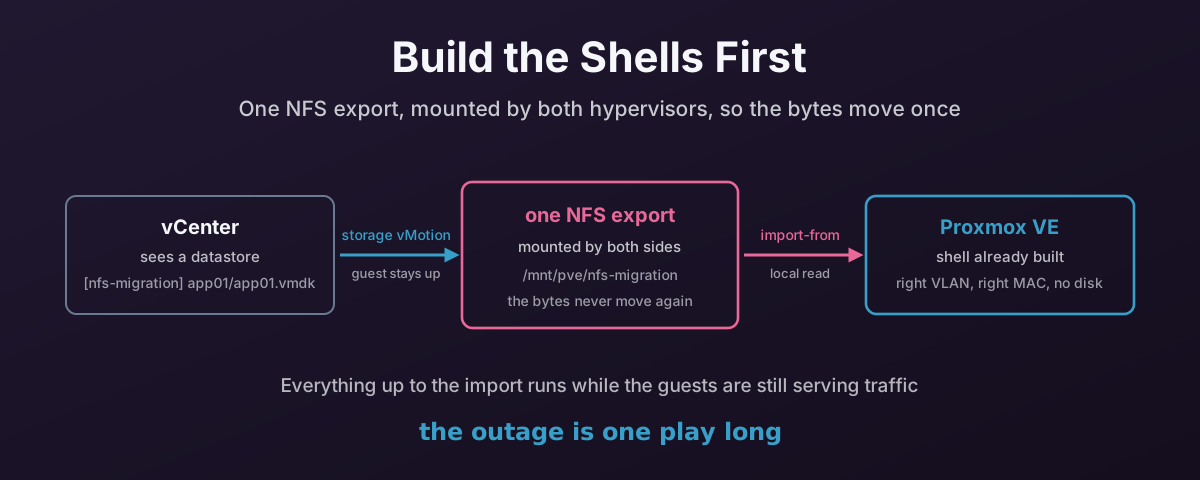
One NFS export mounted by both vCenter and Proxmox, so a VMDK crosses the network once instead of twice

VMware to Proxmox with Ansible — Build the Shells Before You Move a Byte

Reading a vSphere estate with the dynamic inventory, mirroring its VLANs into Proxmox SDN, and rebuilding every VM as a diskless shell before a single disk moves. Why every VMware info module hides the one field the migration needs, why vlan_id is three different types, and why one NFS export mounted twice turns the cutover into a local read.

26th August 2026 · 20 min · 4257 words · Damien Dye
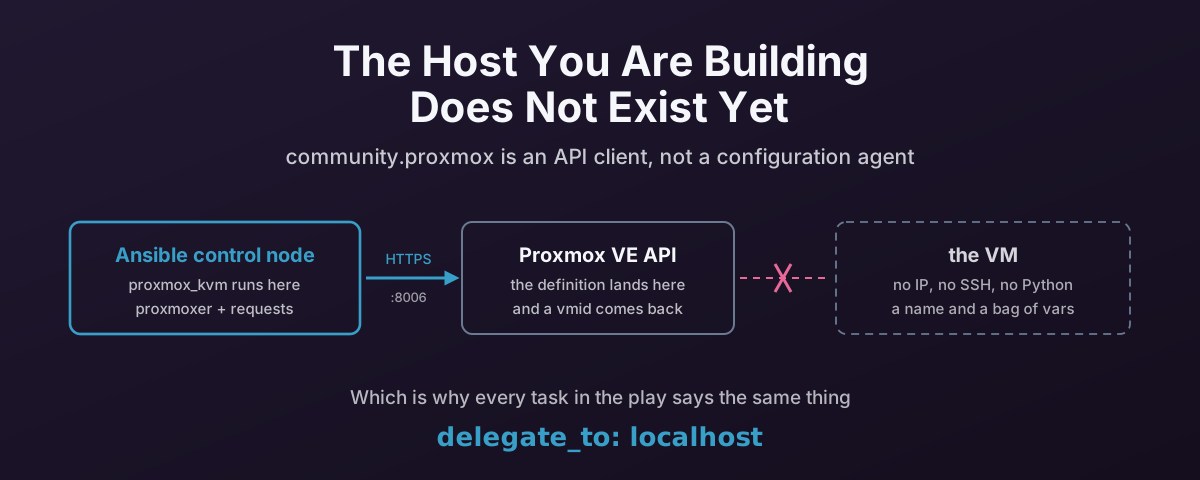
An Ansible control node calling the Proxmox API, with the VM being built having no connection back

Creating Proxmox VMs with Ansible — The Host You Are Building Does Not Exist Yet

The community.proxmox collection is an API client, not a configuration agent, and that changes the shape of every playbook that uses it. Where the tasks actually run, why proxmox_kvm declines to converge rather than updating, why proxmox_disk and proxmox_nic are where disk and NIC changes belong, and the undocumented return value you will end up needing.

12th August 2026 · 25 min · 5224 words · Damien Dye