The Same Budget, A Different Kitchen
The 2026 Budget was sold as “breathing space”1. This post reads it for one household and nothing else. There is a companion piece, Breathing Space For Whom?, on what it does to the big firms and the taxes behind it.
A couple, both 67 or over and past State Pension age, living on nothing but the full new State Pension. That is £241.30 a week each2, £25,095 a year between them. They heat with gas, 13,375 kWh a year, because that is what an ordinary home heated by a gas boiler uses. They run one petrol car, 4,000 miles a year. Council tax band A to D, in England. No savings income, no private pension, no rental.
Be clear what that income is. The State Pension is a benefit, and HMRC lists it among the state benefits you pay income tax on3. They pay none, for one reason only. Income tax is charged person by person, so each of them has their own Personal Allowance of £12,5704, and the full new State Pension is £12,547.60 a year2. With no other income, each pension sits £22.40 under the line. Nor is the pension a pot they saved into that has been sitting there waiting for them. The government’s own description is that it is “unfunded” and “Pay As You Go”, and that “State Pension payments paid to current pensioners are financed from National Insurance contributions paid by current workers”5. They paid for the pensioners before them, and the people in work today pay for them. Every change to it in this Budget is a decision about how much one lot of people pays another.
Question is, does a Budget sold as “breathing space” give them any? Some, once. Then it starts taking it back, and the biggest change to their income is not until 2030.
The Ledger For A Pensioner Couple
Every household measure in the Budget that touches them, from the Treasury’s own document:
| Measure | When | Applies to them? | Worth a year |
|---|---|---|---|
| £100 Household Energy Payment, bands A to D | January 2027 | Yes | +£100, once |
| 0% VAT on electricity, extended three months | April to July 2027 | Yes, 2,500 kWh at 28p, no off-peak EV tariff | about +£11, once |
| 5p fuel duty cut extended six months | to July 2027 | Yes, petrol car | about +£12, once |
| Gas standing charge moved into the unit rate | end of 2027, or later | Yes, and high use loses | −£44 |
| Gas Shipper Obligation moved to general tax | was due 2028 | Yes, and each pension is under the tax-free allowance | about +£5 |
| Electricity standing charge, 54.83p a day at the cap, £200 a year | “details next year” | Stays as it is | £0 |
| £2 bus fare cap | 2027 | No, they already travel free | £0 |
| Pension Credit | No, their income is too high | £0 | |
| Winter Fuel Payment, £100 each | unchanged | Yes, but not new | £0 change |
| Income tax | to April 2030 | None paid, £22.40 under the allowance each | £0 |
| Triple Lock adjusted | April 2030 | Yes | lower rises from 2030 |
The electricity is all bought at the full rate. With no EV there is no cheap overnight tariff worth having, so every one of Ofgem’s typical 2,500 kWh6 costs about 28p. That is £700 a year in units and £200 in standing charge, and 5% VAT on £900 for three months is about £11.
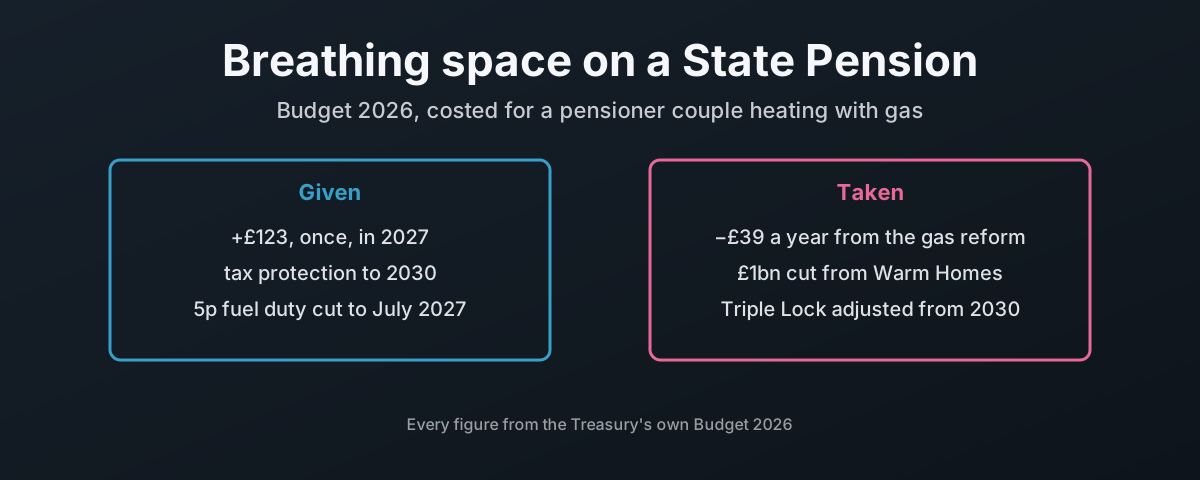
Add it up. In 2027 the couple are about £123 better off, almost all of it the £100 payment. Once the gas reform lands they are about £39 a year worse off, every year. The £123 is gone in a little over three years.
The one-offs are spent by the first spring. What lasts is the gas reform, and it goes the wrong way.
The Gas Reform Works The Wrong Way For Them
Moving the gas standing charge into the unit rate helps a home that uses little gas. It hurts one that uses a lot, and this couple use a lot.
The gas standing charge is £108 a year for the typical billpayer1, 29.68p a day at the October cap7. The Budget asks Ofgem to recover it “through gas unit rates instead”1. Spread across Ofgem’s typical 9,500 kWh6, that adds about 1.14p to every kWh.
| Gas used a year | Standing charge now | Paid back through unit rate | Difference |
|---|---|---|---|
| 9,500 kWh, Ofgem typical | £108 | £108 | £0 |
| 13,375 kWh, this couple | £108 | £153 | −£44 |
A couple who heat their home properly pay £44 a year more. That is exactly what a pensioner couple should be doing in winter. The Treasury knows this. It says “a number of households may be less able to make the most of the reform” and promises “targeted mitigation”1. It does not say what that mitigation is, who gets it, or when.
So the people the reform costs are told help is coming, with no detail. The people it pays, like me, get it automatically.
The Hydrogen Levy, The Other Way Round
The Gas Shipper Obligation was a planned levy on gas bills to pay for hydrogen. The Budget scraps it and pays for the hydrogen out of general taxation instead1. For a salaried household that only moves the bill from the meter to the payslip.
For this couple it is a genuine gain, and fair is fair. A levy on every unit of gas would have charged them by how much gas they burn, and they burn a lot. The government’s own estimate was “approximately £2.60 - £4.50” a year on the average domestic gas bill8, which at their use is about £5. On a full State Pension and nothing else they pay no income tax at all, so the general-taxation version costs them nothing directly. They still pay VAT and every other tax that funds it, but much less of it than they would have paid at the meter.
That does not make hydrogen any better a bet. It means the cost has moved from the household that burns gas to the household that earns a salary.
A Petrol Car Gets The Cut, And Keeps Paying By The Mile
The petrol car gets something. The 5p fuel duty cut, which was due to end in January, is extended “by a further six months to 1 July 2027”1.
| Fuel duty extension, petrol car | Figure |
|---|---|
| Miles a year | 4,000 |
| Fuel economy, an ordinary small petrol car | 45 mpg, assumed |
| Litres a year | about 404 |
| Litres in the extra six months | about 202 |
| Pump price now, petrol | £1.97 a litre |
| Fuel bill a year | about £796 |
| 5p cut plus the VAT charged on it | 6p a litre, about 3% of the pump price |
| Saving from this Budget | about £12, once |
So on a fuel bill of about £796 a year, at £1.97 a litre, the extension is worth £12. Even with the cut, nearly £800 a year goes into the tank.
And they already pay a per-mile tax. It is called fuel duty. Petrol pays 52.95p a litre9, and the duty carries VAT on top. At 45 mpg that is:
| Tax by the mile | Petrol car, fuel duty | Electric car, eVED from April 2028 |
|---|---|---|
| Per mile | about 5.3p, 6.4p with VAT | 3p10 |
| On 4,000 miles | about £214, £257 with VAT | £120 |
So the new Electric Vehicle Excise Duty is not a per-mile tax arriving for the first time. Petrol drivers have paid one at every fill-up for as long as there has been fuel duty, and at about twice the eVED rate. The Budget’s 5p cut trims it for six months. It does not stop it.
Keeping people on oil is bad policy, and I have said so. On this household it is still a small, real benefit.
Too Much For Pension Credit, Not Enough For Anything Else
Here is the one that does not show on any bill. Pension Credit tops a couple’s income up to “£363.25 if you have a partner”11. This couple have £482.60 a week between them. They are £119.35 a week over, so they cannot claim it, and they get nothing that comes with it.
| Couple’s weekly income | Amount |
|---|---|
| Full new State Pension, two of them | £482.60 |
| Pension Credit tops a couple up to | £363.25 |
| Over the line by | £119.35 |
Too well off for the help aimed at the poorest pensioners. Still on a fixed income. And that income has to cover a gas bill the Budget has just made bigger. The Winter Fuel Payment does reach them, “£100 if you and the person you live with were both born between 28 September 1946 and 27 June 1960”12, £200 between them. This Budget does not change it.
They do not need the £2 bus fare cap either. The age for a free bus pass depends on where you live13:
| Where | Free bus travel from |
|---|---|
| Scotland, Wales, Northern Ireland | 60 |
| London, within London only | 60 |
| England outside London | State Pension age, 66 rising to 67 |
The post takes the highest, because that is the one most of England lives under. State Pension age is rising from 66 to 67 “between 2026 and 2028”14, so the pass in England now arrives at 67, seven years after a pensioner in Cardiff or Glasgow gets theirs. This couple are past it, so they travel free. That is a real benefit. It is just not a new one, and an English couple waited longest for it.
The Licence, The Specs, And Who Pays
Being over the Pension Credit line costs more than the top-up itself, because so much other help hangs off it. Glasses are the clearest case.
An NHS sight test is free for “anyone aged 60 or over”. The glasses are not. An NHS optical voucher towards them goes to people on, among other things, “Pension Credit Guarantee Credit”15. This couple cannot get Pension Credit, so they get no voucher, and they pay for their own glasses. The only route left is the means-tested NHS Low Income Scheme, which is a form to fill in and may give partial help or none.
And the driving licence is about to lean on exactly that. The Department for Transport has consulted on “Introducing mandatory eyesight testing for older drivers”, for “drivers aged 70 and over” as “part of the driving licence renewal process”, replacing the “current self-declaration system”16. The consultation closed on 11th May 2026 and the outcome is not out yet. It does not say who pays. The optometrists’ own body says plainly that “Any additional costs to cover the administration of this must be funded by the driver”17.
| Older driver, over the Pension Credit line | Who pays |
|---|---|
| Sight test | free on the NHS from 6015 |
| Glasses the test says they need | them, no voucher15 |
| Any administration of a mandatory licence eyesight check | not decided, the optometrists say the driver17 |
None of this is in the Budget, and that is the point. A couple on a fixed income keep the car because it is how they get to the shops and the surgery. The state is moving towards making them prove their eyesight to keep it, and the glasses that let them pass come out of the same State Pension the gas bill does.
Protected From The Freeze, Until It Runs Out
That £22.40 of room under a frozen allowance is all that keeps a State Pension on its own out of income tax.
Fiscal drag works differently on them. Somebody in work pays it in cash every year, because each pay rise lands in a band that should have moved. This couple pay nothing yet, because their whole income sits under the allowance. What the freeze takes from them is the room. Run the law’s own indexing rule18 on the ONS’s September inflation figures19 and the allowance would look like this:
| Tax year | Personal Allowance, indexed | Frozen | Room over one State Pension, indexed | Room, frozen |
|---|---|---|---|---|
| 2026-27 | £16,080 | £12,570 | £3,532 | £22 |
| 2027-28 | £16,650 | £12,570 | £3,663 | −£417 |
The 2027-28 row assumes the Triple Lock pays only September’s 3.5% inflation, which is the least it can pay. That takes the full new State Pension to £249.75 a week, £12,987 a year, and puts each of them £417 over the frozen allowance. At 20% that is about £83 each, £167 for the couple, every year, in tax that only exists because of the freeze. Indexed, a State Pension would not have come near income tax at all.
So on a pensioner the drag does not show as a bill. It shows as a new relief. The Budget brings in a Pension Tax Allowance from April 2027, so that pensioners “with incomes at or under the value of the full new State Pension will not be brought into paying tax because of State Pension uprating in this Parliament”1.
It is a patch over a hole the freeze dug, and it is the right thing to do. Now read the dates:
| Until | |
|---|---|
| Pension Tax Allowance | “6 April 2027 until 5 April 2030”1 |
| Personal Allowance frozen at £12,570 | 5th April 20314 |
The protection ends a year before the freeze does. For 2030-31 the Treasury says only that it “will consider arrangements beyond April 2030 in the usual way”1. So a couple on nothing but their State Pension have a year in which, on the rules as written today, the freeze could put them into income tax, and the fix for it is a promise to think about it later.
Add A £790 Pension From Work, And Fiscal Drag Takes It
Now give one of them a pension from work. Auto-enrolment reached them four years before they retired, and the employer paid in only what the law made it, which since April 2019 is 3% of qualifying earnings20. Four years at the legal minimum buys an annuity of about £790 a year. Plenty of people retiring now have about that, because the minimum was all they were ever given and it came too late to build anything bigger.
The other partner is unchanged. Here is what the £790 is worth to the one who has it:
| Tax year | Income | Over the allowance | Income tax | £790 annuity, kept |
|---|---|---|---|---|
| 2026-27 | £13,337.60 | £767.60 | £153.52 | £636.48 |
| 2026-27, if the allowance had been indexed | £13,337.60 | £0 | £0 | £790 |
| 2027-28, frozen, Pension Tax Allowance | £13,777 | £1,207 | £158 to £241 | £549 to £632 |
| 2027-28, if the allowance had been indexed | £13,777 | £0 | £0 | £790 |
| 2030-31 onwards, Pension Tax Allowance gone | at least £13,777 | at least £1,207 | at least £241 | at most £549 |
Read the indexed rows first. With the allowance kept in line with prices, £16,080 this year and £16,650 next, the annuity is not taxed at all, and there would still be £2,700 or more of room to spare. Every pound of tax in this table is fiscal drag and nothing else. No rate went up. The allowance stood still while the State Pension rose to meet it.
This year the £790 takes their income £767.60 over the frozen allowance, and 20% of that is £153.52.
From April 2027 the Pension Tax Allowance does not save them. It is only for pensioners whose income “regardless of source, is below or at the value of the full new State Pension”, and for anyone “just above”, it is “gradually withdrawn through a taper”1. The Treasury has not published the taper, so the tax sits between £158, which is 20% of the annuity alone, and £241, which is 20% of everything over the frozen allowance. From April 2030 the Pension Tax Allowance ends and the freeze does not, so it is £241 or more, and it grows with every State Pension rise.
They will not get a bill for it. HMRC collects the tax owed on a State Pension through the private pension: “you’ll usually pay more tax to include any tax you need to pay on your State Pension. Your tax code will change to collect this”21. So the annuity arrives already cut, and £83 of the £241 is the State Pension being taxed back through it. That is 31% off a £790 annuity, not the 20% basic rate it looks like it should be.
Can I ask why somebody who did what they were told, stayed in the workplace scheme for the four years it existed for them and saved, ends up with the State Pension taxed through their savings? The employer paid the minimum because the minimum is all it had to pay. The government froze the allowance because the freeze raises money without a headline. Between them, nearly a third of a small pension comes off every year, and an indexed allowance would have left every penny of it alone.
The Triple Lock Comes Off In 2030
The biggest change to this couple’s income is not in the ledger, because it does not start until April 2030.
Until then the State Pension rises “by the highest of 2.5%, inflation or earnings growth”1. From April 2030 it rises “by the highest of 2.5%, inflation, or the amount required to maintain its value relative to earnings as reached in April 2029”1. The Treasury calls that removing the “ratchet”. What it is worth to the Treasury, in its own words:
| Adjusted Triple Lock, reduction in State Pension spending | Treasury estimate |
|---|---|
| By the late 2030s | £15 billion a year |
| By the late 2040s | £50 billion a year |
That money does not come from nowhere. It comes out of State Pension rises that would otherwise have been paid, which means out of the income of every pensioner living on it. The Budget says it will fund a National Care Service with personal care “free at the point of use”1, and that may well be worth having. But the people paying for it are the same people who will need it, and the couple in this post pay first, in every rise from 2030 that is smaller than it would have been.
Nothing For The Boiler
This is the house that insulation and heat pump money would help most.
A couple using 13,375 kWh of gas a year are exactly who the Warm Homes Plan is for. This Budget takes £1 billion of its capital grant to pay for defence1. It holds the heat pump grant at £400 million a year1, at £7,500 a heat pump22. And it lets VAT on installing insulation, heat pumps, solar and batteries go back up from 0% to 5% from April 202723.
| What would cut their bill for good | What the Budget does |
|---|---|
| Insulation | VAT back up to 5%, Warm Homes grant cut by £1 billion |
| Heat pump | grant held flat, VAT back up to 5% |
| Solar and a battery | VAT back up to 5% |
On a fixed income with no savings, none of that kit gets bought without help. So the couple keep the gas boiler, keep burning 13,375 kWh, pay the bigger unit rate from the standing charge reform, and wait for next winter’s £100.
A Fixed Income Cannot Graft Its Way Out
A working household can take on more work, change jobs, or put its own money into solar and a battery. A pensioner couple on a fixed income have none of those. Their income moves when the government moves it, and from 2030 it will move less. Their energy bill is set by a market that this Budget subsidises rather than fixes, and the one reform that touches their bill directly costs them £44 a year with “targeted mitigation” left blank.
What they need is the thing nobody in this Budget is willing to pay for once: their home insulated and their boiler replaced, so the bill comes down and stays down. What they get instead is £100, paid for by everyone, routed through the council tax to the same energy companies, and needed again next year. That is not breathing space. It is being kept on the same old gas, at the same old price, a winter at a time.
HM Treasury — Budget 2026: Breathing Space for Today, Fresh Hope for the Future — the Budget report laid before Parliament on 28th October 2026. Triple Lock 1.28, 1.29, 5.23 and Box 5A; Pension Tax Allowance 3.19 and 6.182; energy measures 3.4 to 3.9 and 6.24 to 6.27; fuel duty 3.13 and 6.211; Warm Homes Plan and Boiler Upgrade Scheme 4.36. ↩︎ ↩︎ ↩︎ ↩︎ ↩︎ ↩︎ ↩︎ ↩︎ ↩︎ ↩︎ ↩︎ ↩︎ ↩︎ ↩︎ ↩︎
GOV.UK — The new State Pension: what you’ll get — “The full rate of new State Pension is £241.30 a week.” ↩︎ ↩︎
GOV.UK — Income Tax: taxable and tax-free state benefits — the State Pension is listed among the taxable state benefits. ↩︎
HMRC — Maintaining the Personal Allowance and basic rate limit until 5 April 2031 — Personal Allowance held at £12,570 “until 5 April 2031”. ↩︎ ↩︎
DWP — Third State Pension age review: independent report call for evidence — the National Insurance Fund pays the State Pension; “this is unfunded and is often referred to as a “Pay As You Go” system”. ↩︎
Ofgem — Summary of changes to the energy price cap, revised TDCV — typical consumption from 1st July 2026: “2,500 kWh of electricity, 9,500 kWh of gas”. ↩︎ ↩︎
Ofgem — Changes to energy price cap between 1 October and 31 December 2026 — gas standing charge 29.68p a day and unit rate 7.97p/kWh including VAT; electricity unit rate 26.32p/kWh and standing charge 54.83p a day, without VAT to 31st March 2027. ↩︎
DESNZ — Gas Shipper Obligation analytical annex — “approximately £2.60 - £4.50” a year on the average domestic gas bill, 2028 to 2037. ↩︎
GOV.UK — Tax on shopping and services: Fuel Duty — petrol, diesel, biodiesel and bioethanol “52.95 pence per litre”. ↩︎
HM Treasury — Electric Vehicle Excise Duty (eVED) — 3p a mile for electric cars, 1.5p for plug-in hybrids, from 1st April 2028. ↩︎
GOV.UK — Pension Credit: what you’ll get — tops up “your joint weekly income to £363.25 if you have a partner”. ↩︎
GOV.UK — Winter Fuel Payment: how much you’ll get — £100 each for a couple both born between 28 September 1946 and 27 June 1960 who do not get a qualifying benefit. ↩︎
GOV.UK — Apply for an older person’s bus pass — “free travel when you reach the State Pension age” in England; at 60 in London, Wales, Scotland and Northern Ireland. ↩︎
DWP — State Pension age timetable — “The State Pension age for men and women will now increase to 67 between 2026 and 2028.” ↩︎
NHS — Free NHS eye tests and optical vouchers — free sight tests for anyone aged 60 or over; vouchers towards glasses for people receiving Pension Credit Guarantee Credit and other listed groups, not for age alone. ↩︎ ↩︎ ↩︎
Department for Transport — Introducing mandatory eyesight testing for older drivers — consultation, 7th January to 11th May 2026, outcome awaited. ↩︎
Association of Optometrists — response on mandatory eyesight testing for older drivers — May 2026. ↩︎ ↩︎
Income Tax Act 2007, section 57 — the Personal Allowance is indexed by “the consumer prices index for the September before the start of a tax year” and rounded “up to the nearest amount which is a multiple of £10”. ↩︎
ONS — CPI annual rate, all items, series D7G7 — September 2021 3.1%, 2022 10.1%, 2023 6.7%, 2024 1.7%, 2025 3.8%, 2026 3.5%. ↩︎
GOV.UK — Workplace pensions: what you, your employer and the government pay — from April 2019 the minimum an employer pays is 3%, with a total minimum contribution of 8%. ↩︎
GOV.UK — Tax when you get a pension: how your tax is paid — if you get a private pension, “Your tax code will change to collect” the tax on your State Pension. ↩︎
GOV.UK — Boiler Upgrade Scheme: what you can get — £7,500 towards an air source or ground source heat pump. ↩︎
HMRC — VAT on energy-saving materials and heating equipment (VAT Notice 708/6) — zero rate “from 1 May 2023 to 31 March 2027”, covering insulation, heat pumps, solar panels and batteries. ↩︎