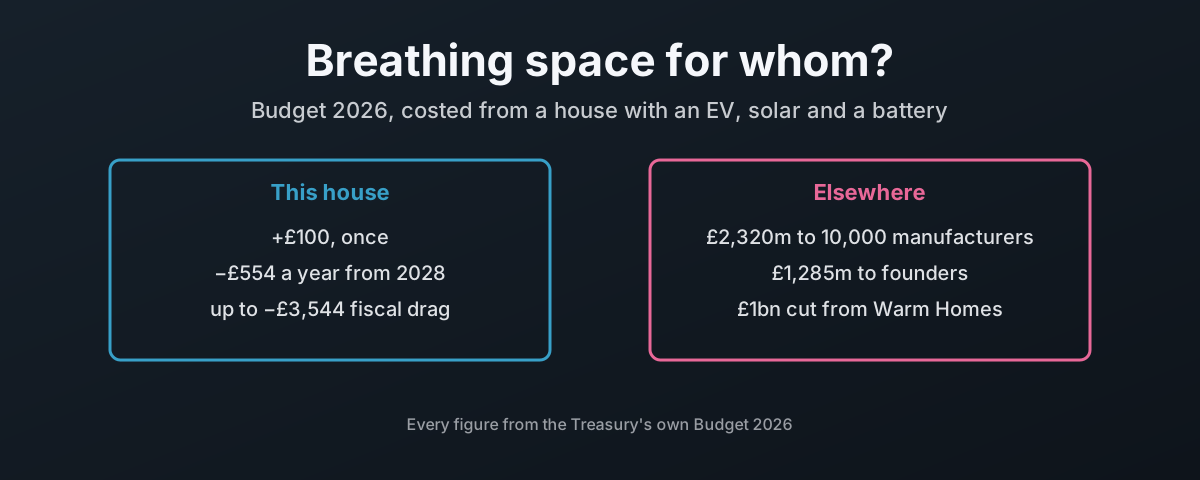
A Breathing Space Budget, Read From My Kitchen
The 2026 Budget was delivered today under the title Breathing Space for Today, Fresh Hope for the Future1. The pitch is help with energy bills, help for drivers and help for the high street, paid for by banks and by people with savings and rental income.
So I did what I do with any bill. I read the document and costed it against my own house.
The house is a fairly ordinary one for someone in my line of work. A 40% taxpayer. I work from home, but my other half still drives to the office, so the EV does about 20,000 miles a year. Solar on the roof and a battery in the garage, and every unit we import comes in at a 7p off-peak rate. Gas is still connected, but it is down to hot water and a little heating, about 5,350 kWh a year. Council tax band A to D, in England. No savings income and no rental income, because a mortgage the size of ours leaves nowt over to save.
None of that kit came from a handout. I have put my own money into cutting my own bill: the solar, the battery, the EV, and working the gas down year by year. I did it to stand on my own feet, not in the hope of a grant, and I am not asking for one now. What I do expect is not to be made to pay more for having done it.
Question is, does a house like that get anything from this Budget other than a tax bill? Mostly no. Here is the working.
Every figure below comes from the Treasury’s own document, Ofgem, HMRC or the government’s own consultation papers, not from the speech and not from the press coverage. A summary of the Budget doing the rounds today got several things wrong, and where it did I have said so.
The Ledger For A House Like Mine
This is every household measure in the Budget that could touch this house, and what it is worth here. Plus signs are money in, minus signs are money out.
| Measure | When | Applies here? | Worth a year |
|---|---|---|---|
| £100 Household Energy Payment, bands A to D in England | January 2027 | Yes | +£100, once |
| 0% VAT on electricity, extended three months | April to July 2027 | Yes, but everything imported is at 7p off-peak | a few pounds, once |
| Gas standing charge, 28.75p a day, moved into the unit rate | end of 2027, or later | Yes, and low use wins | +£46 |
| Electricity standing charge, 56.61p a day, £207 a year | “details next year” | Stays exactly as it is | £0 |
| Gas Shipper Obligation moved to general tax | was due 2028 | Off the bill, onto tax | about £0, paid another way |
| 5p fuel duty cut extended | to July 2027 | No, it is an EV | £0 |
| Tax-free mileage up to 55p and 35p | April 2027 | No, commuting does not count2 | £0 |
| £2 bus fare cap | 2027 | No buses | £0 |
| Cheaper local public EV chargers | Spring 2027 | No, it charges at home | £0 |
| Savings and property income tax up 2 points | April 2027 | No savings, no rental | £0 |
| Cash ISA kept at £20,000 | 2027 | No, nothing left over to save | £0 |
| Lifetime ISA, Your First Home | 2027 | No, we already worked for our home | £0 |
| Electric Vehicle Excise Duty at 3p a mile, 20,000 miles | April 2028 | Yes | −£600, rising with CPI |
| Income tax thresholds frozen, fiscal drag | to April 2031 | Yes | up to −£3,544 this year, −£4,112 in 2027-28 |
Add it up. In 2027 the house is a little over £100 better off, and almost all of that is a single £100 payment. From April 2028 the yearly measures settle at about £554 a year worse off, every year, rising with inflation. eVED alone takes £50 a month, so the £100 is gone two months after it starts, and it does not come back. And that is before fiscal drag, which on its own can cost a 40% taxpayer up to £3,544 this year.
A Gas Saving, And No Electricity One
Credit where it is due. This one is a genuine gain, and it cuts against my own starting position.
Gas standing charges are £108 a year for the typical billpayer, by the Treasury’s own figure1. Ofgem’s October cap puts the gas standing charge at 29.68p a day, which is the same £1083. You pay it whether you burn a lot of gas or almost none, which is exactly the wrong way round for a house that has been working its gas use down.
The Budget asks Ofgem to abolish it on domestic bills, “aiming for delivery by the end of 2027 or as soon as possible after then”, with suppliers recovering the cost “through gas unit rates instead”1.
The details are not set yet, so this is an estimate, not a quote. If that £108 is spread across Ofgem’s typical household’s 9,500 kWh4, it adds about 1.14p to every kWh. At 5,350 kWh this house pays about £61 of it back through the unit rate and stops paying £108 in fixed charges. That is about £47 a year better off at the cap. This house’s own tariff charges 28.75p a day, £105 a year, and on the same sum it comes out at about £46 a year better off.
| Gas used a year | Standing charge now | Recovered through unit rate | Difference |
|---|---|---|---|
| 5,350 kWh, this house’s use, at the cap | £108 | £61 | +£47 |
| 9,500 kWh, Ofgem typical | £108 | £108 | £0 |
| 14,000 kWh, a big old house | £108 | £160 | −£52 |
The break-even is the typical house. Anyone using less wins, and anyone heating a big draughty house on gas loses, which the Treasury concedes when it says “a number of households may be less able to make the most of the reform” and promises “targeted mitigation”1. As such, it is a fair reform, and it rewards the households that already cut back. I will take the £46.
Now the other one. For a house with solar and a battery, the fixed charge that matters is not the gas one. It is the electricity standing charge. This house pays 56.61p a day, against 54.83p at October’s cap3, and that is £207 a year, nearly twice its gas charge. The more of your own power you make and store, the bigger a share of your electricity bill that fixed charge becomes, because it is paid in full whether you import 3,000 kWh or 30. At the 7p this house pays for off-peak power, £207 of standing charge is the price of about 2,950 kWh of electricity, paid before a single unit comes in.
The 0% VAT on electricity does not do much here either. VAT is charged on the 7p, so it was only ever 0.35p a kWh. The three-month extension is worth about £2.50 on the standing charge and 35p for every 100 kWh imported. Cheap off-peak power was the saving. The VAT cut is the small change on top of it.
The Budget does not move it into the unit rate. It commits only to “reform electricity standing charges”, with details “next year”1. So the reform rewards the household that cut its gas, and leaves the household that generates its own electricity paying the largest fixed charge on its bill, untouched.
The Hydrogen Levy Moved, It Did Not Go Away
The Budget lists scrapping the Gas Shipper Obligation as “providing savings for businesses and households”1. It is not a saving. It is the same bill, sent to a different address.
The Gas Shipper Obligation was a planned levy. It had not started. Its own consultation describes it as “a funding mechanism for the Hydrogen Production Business Model”5, charged to gas shippers and passed on per unit of gas, with the government’s estimate of the cost to the average household at “approximately £2.60 - £4.50” a year over 2028 to 20376. On this house’s gas use that is about £2 a year.
The Budget scraps it before it ever reached a bill. In its place: “Hydrogen Allocation Round 1 funding will be met with a £27 million uplift to DESNZ RDEL in 2027-28”, and the government will publicly fund future hydrogen contracts “if the government commits to them and subject to value for money”1.
So the hydrogen still gets paid for. It is £27 million next year from general taxation, and the promise to “publicly fund” future contracts has no ceiling on it at all. We are all still paying it, through the tax return instead of the meter.
And which of those you pay through matters. A levy on each unit of gas charges you by how much gas you burn, so a house that has cut its gas to hot water pays very little of it. General taxation charges you by income. For a low-gas 40% taxpayer that is the wrong way round: the £2 comes off the gas bill, and a share of the cost goes back on at the higher rate. The ones who come out ahead are the heavy gas users, the big industrial sites first, because they were the ones the per-unit levy would have charged most.
The summary going round today got two other things wrong. The levy was never on anyone’s bill, because it had not started. And it does not go to oil and gas companies.
These are the eleven projects from the first round, from the government’s own list7:
| Project | Lead developer | Capacity |
|---|---|---|
| Barrow Green Hydrogen | Carlton Power | 21.0 MW |
| Bradford Low Carbon Hydrogen | Hygen | 24.5 MW |
| Cromarty Hydrogen | Scottish Power and Storegga | 10.6 MW |
| Green Hydrogen 3 | HYRO | 10.6 MW |
| HyBont | Marubeni Europower | 5.2 MW |
| HyMarnham | JG Pears and GeoPura | 9.3 MW |
| Langage Green Hydrogen | Carlton Power | 7.0 MW |
| Tees Green Hydrogen | EDF Renewables Hydrogen | 5.2 MW |
| Trafford Green Hydrogen | Carlton Power | 10.5 MW |
| West Wales Hydrogen | MorGen Energy and Trafigura | 14.2 MW |
| Whitelee Green Hydrogen | Scottish Power | 7.1 MW |
Every one is electrolytic hydrogen, made from electricity. The developers are power companies, renewables arms and trading houses. BP, Shell and the rest of the North Sea are not on it.
Hydrogen Is The Wrong Bet
The first round was agreed at “a weighted average strike price of £241/MWh” and will pay “over £2 billion of revenue support”7 for 125 MW of production.
Put that strike price in household terms. £241 a MWh is 24.1p a kWh. Gas under the October cap is 7.97p a kWh, VAT included3. So the hydrogen is being bought at three times what a household pays for the gas it would replace, and the £2 billion is there to cover the gap, because it could not sell at the market price on its own. That is what the Gas Shipper Obligation was for. It was a subsidy for a fuel that cannot compete, and moving it to general taxation keeps the subsidy and only changes who signs the cheque.
So what is the taxpayer buying?
Look at the list again. Every one of those projects makes hydrogen out of electricity. So the plan is to take electricity, lose a large part of it turning water into a gas, pipe the gas about, and burn it. Meanwhile the same electricity put into a heat pump comes out as nearly three times as much heat:
| What 1 kWh of electricity does | Result |
|---|---|
| Runs an air source heat pump, median of 742 UK homes | 2.8 kWh of heat, 280%8 |
| Makes hydrogen to burn for heat instead | needs “five to six times more electricity” for the same heat9 |
Those figures come from the research, not from me. A review of 32 independent studies found hydrogen heating less efficient and dearer per unit of heat than heat pumps, and as reported it “makes absolutely no sense for heating homes and buildings”9. A heat pump is better than 100% efficient because it moves heat rather than making it. Hydrogen can never get there, because it starts from the electricity and loses some of it at every step.
So hydrogen is a waste of time and money, and this country should be going 100% electric: heat pumps and the rest of the kit that gets more than a unit of heat out of every unit of power, and EVs on the road. The Budget does the opposite. It holds the heat pump grant flat, cuts a billion from Warm Homes, and promises to publicly fund every future hydrogen contract the government signs, with no limit written on it.
The Road Tax That Outweighs The Lot
Now the measure that actually costs this house money, and the Budget is quite open about why it is there. It lists Electric Vehicle Excise Duty as part of “strengthening the tax base … to respond to the long-term decline in fuel duty receipts”1.
eVED was announced at Budget 2025 and this Budget confirms it, with a mileage estimation tool and an opt-in “eVED Connect” that reads your mileage from the car1. The rate is “3 pence per mile for BEVs” and “1.5 pence per mile for PHEVs”, from 1st April 2028, rising with CPI from 2029-3010.
At 20,000 miles a year that is £600. Every year, indexed. Most of those miles are a commute to an office, and the tax-free mileage rates the Budget raises do not cover travel “to and from your work, unless it’s a temporary place of work”2. So the commute gets the new tax and none of the relief.
Set that against the fuel duty line. The 5p cut has now been extended for the sixth time1:
| Same Budget, two cars | Petrol or diesel | This EV |
|---|---|---|
| 5p fuel duty cut and RPI deferral, £1,355 million | gets it | £0 |
| eVED from April 2028 | not charged | 3p a mile, £600 a year at 20,000 miles |
The house that did what the government asked is the one it is now going back to for the revenue.
Does the fuel duty cut at least help people onto something cheaper? Look at where the transport money in Table 6.1 goes1:
| Transport measure in Table 6.1 | Cost | Pushes people towards |
|---|---|---|
| 5p fuel duty cut and RPI deferral | £1,355 million, two years | petrol and diesel |
| Tax-free mileage rates up | £230 million, two years | driving more business miles |
| £2 bus fare cap | £230 million, two years, from energy budgets | the bus |
| Cheaper local public EV chargers, method not yet set | £100 million, two years, then nothing | electric |
| Removing Carbon Price Support | £235 million, five years from 2028 | cheaper fossil-fuelled generation |
It does not fix the move to cheaper transport. It pays people to stay on oil. Fuel duty is a price signal, and with diesel “exceeding £2 per litre in October 2026”1 the Treasury has chosen to blunt it again rather than spend the money on the way out of it. The bus cap and the chargers together get about a quarter of what the pump gets, and the charger money is not even a scheme yet. It is £100 million to “reduce costs for local, lower-powered public chargers” from Spring 2027, worth “around £150 per year” to a driver who charges on the street, with the Department for Transport to “set out next steps in due course”. Letting those drivers use their home tariff at a public charger, which would actually fix it, is a taskforce “to explore” a “complex proposal that will take time to consider”1. Every extension makes the next one harder to end, and the households that already left oil behind are the ones paying the per-mile tax for it.
Fiscal Drag, The Tax Rise Nobody Announces
The biggest tax on a 40% taxpayer needs no new announcement at all, and it can already cost nearly six times what eVED will. It is fiscal drag.
The Personal Allowance and the basic rate limit were fixed “at their 6 April 2021 levels”, and they are now held “until 5 April 2031”11. That is ten years at £12,570 and a higher rate threshold of £50,270, while the Budget itself says “consumer prices today are around 33% higher than the 2020 average”1. Every pay rise that only keeps up with prices pushes more of your income into the 40% band. Your pay is worth no more, and you pay more tax on it.
| Fiscal drag, by the government’s own figures | |
|---|---|
| Thresholds fixed at | 6th April 2021 levels |
| Frozen until | 5th April 2031, ten years |
| Prices since 2020 | around 33% higher |
| Extra tax from the 2028 to 2031 extension alone | £3,365m, £7,780m, then £12,435m a year |
| People pulled into income tax by 2030-31 | 700,000 |
The revenue row is the Treasury’s own costing11, and it shows the drag growing, because every year frozen stacks on the year before.
So where would the thresholds be if they had never been frozen? The law already says how to work it out. Both go up each April by the consumer prices index “for the September before the start of a tax year”, the Personal Allowance rounded up to the next £1012 and the basic rate limit to the next £10013. Here is that rule run on the ONS’s own September figures, 3.1%, 10.1%, 6.7%, 1.7%, 3.8% and 3.5%14:
| Tax year | Personal Allowance, indexed | Higher rate threshold, indexed | Frozen at | Extra income tax, 40% payer |
|---|---|---|---|---|
| 2022-23 | £12,960 | £51,860 | £12,570 and £50,270 | £396 |
| 2023-24 | £14,270 | £57,170 | £12,570 and £50,270 | £1,720 |
| 2024-25 | £15,230 | £61,030 | £12,570 and £50,270 | £2,684 |
| 2025-26 | £15,490 | £62,090 | £12,570 and £50,270 | £2,948 |
| 2026-27 | £16,080 | £64,480 | £12,570 and £50,270 | £3,544 |
| 2027-28 | £16,650 | £66,750 | £12,570 and £50,270 | £4,112 |
The higher rate threshold should be £64,480 now, not £50,270. That is £14,210 of income now taxed at 40% that the law would otherwise have taxed at 20%, or not at all.
The extra tax column is for a 40% taxpayer earning above the indexed threshold and below £100,000. Each extra pound of Personal Allowance saves 40p and each extra pound of basic rate band saves 20p, so 2026-27 is £3,510 at 40% plus £10,700 at 20%. Add the five years to April 2027 together and it is £11,292, before a single new tax is announced. It is income tax only, and it leaves National Insurance out, because indexing the upper NI limit would have put more of the same income at the 8% rate rather than 2%, which pulls the other way.
Nobody stands up and announces it each year. It is the tax a 40% taxpayer pays most reliably, and it is the one this Budget chose to leave alone.
And The Low Paid Pay It First
In pounds, the 40% band loses most to the freeze. But look at who it bites hardest. Here is the same rule run for four workers in 2026-27, income tax only:
| Worker, 2026-27 | Income tax paid now | If thresholds had kept up | Extra a year | Share of pay |
|---|---|---|---|---|
| Part-time, £16,000 | £686 | £0 | £686 | 4.3% |
| Full-time on the National Living Wage, £23,132 | £2,112 | £1,410 | £702 | 3.0% |
| £40,000 | £5,486 | £4,784 | £702 | 1.8% |
| 40% taxpayer, £70,000 | £15,432 | £11,888 | £3,544 | 5.1% |
The part-timer is the one to look at. Everyone earning between £12,570 and £16,080 now pays income tax on money the law would have left alone, and the policy paper expects the freeze to bring “700,000 individuals into Income Tax by 2030 to 2031”11. A 40% taxpayer can absorb £3,544 and grumble. £686 out of £16,000 was never spare. And National Insurance starts at the same frozen £12,570, so the low paid pay that on top.
Now the headline the Budget does want you to see. The National Living Wage goes up to £13.21 an hour in April 2027, “equivalent to an increase of £910 in the gross annual earnings of a full-time worker”1, from £12.71 now15. In that same year, 2027-28, the frozen Personal Allowance takes £816 more income tax off that same worker than the law would have. The rise is real. The Treasury has already spent most of it.
Then the people it chose to protect. From April 2027 a new Pension Tax Allowance means pensioners “with incomes at or under the value of the full new State Pension will not be brought into paying tax because of State Pension uprating in this Parliament”1. That is a fix for the freeze, and it is a fair one. Can I ask why it stops at pensioners? A worker on the same income, doing a full week for it, gets no allowance at all.
Help With The Bill, Or A Subsidy For A Failing Market?
Start with what the £100 actually is. The summary going round today called it a payment into your bank account. The Budget calls it a “£100 council tax rebate for households in bands A to D”1, delivered by councils from January 2027. Either way, it is spent on the energy bill.
And neither it nor the 0% VAT changes what the energy costs. The bill stays the same size. The taxpayer just pays part of it. So where does a bill go? Ofgem’s own breakdown of the typical bill from July 20264:
| Where the typical bill goes, July to September 2026 | Share |
|---|---|
| Wholesale energy, including contracts for difference | 45% |
| Networks | 25% |
| Operating, debt and industry costs | 16% |
| Policy costs | 6% |
| VAT | 5% |
| Profit allowance for the supplier (EBIT) | 2.6% |
| Headroom and levelisation | 1.5% |
Seven pounds in every ten go to the generators and the network companies. A profit margin for the supplier is written into the cap itself. So the £3,685 million is public money, raised through general taxation with a bank surcharge helping, and every pound of it ends up in those same private hands. It is not help with energy. It is a subsidy to the energy market, routed through your council tax so it looks like help.
A subsidy for what, exactly? By the Treasury’s own account, household energy prices are up 73% on the 2020 average1, and household energy debt “has almost tripled to over £5 billion”1. A market that has run up that much household debt since Russia invaded Ukraine is a failing market. This Budget does not fix it. It pays the bill for it this winter, and it will have to pay it again next winter, because nothing in the price has moved.
Set that against what the same Budget asks back from the generators. The Electricity Generator Levy goes from 45% to 55% until March 2028, and Table 6.1 has it raising £95 million1. Over the next six years the taxpayer puts £3,685 million into the bills those generators are paid from. The windfall levy takes £95 million back out. That is nearly 39 to 1.
The banks paying £1,475 million of it through the surcharge is the fair part, and I will say so. But a subsidy that leaves the price where it is buys nothing that lasts. The only energy help that does is the kind in “Nothing For The Roof” below, the kind that makes a house need less of it.
Who Gets The Money Instead
If not this house, then who? The Budget’s own costings table, Table 6.1, gives the cost of every measure from 2026-27 to 2031-321, so this needs no guessing. Here are the biggest giveaways, summed over the six years.
The households bar looks like the biggest giveaway of the lot. The section above is where that money actually ends up.
Look down the pink bars, though.
- 10,000 manufacturers, £2,320 million. From April 2027 the British Industrial Competitiveness Scheme exempts “eligible businesses … from the indirect costs of the Renewables Obligation, Feed in Tariffs and Capacity Market schemes”1, cutting their electricity bills “by up to 25%”. In 2027-28 alone that is £1,235 million, an average of about £123,500 a firm, against £100 a household. Those same three schemes stay on every kWh this house imports.
- Energy-from-waste, £1,505 million. Delaying the carbon price on burning waste. This one needs more than a line, so it gets its own paragraphs below.
- Founders, £1,285 million. A new Founders’ Relief: “a 10% CGT rate on up to £10 million of lifetime gains for qualifying founders of high-growth, innovative companies”1.
The energy-from-waste line in Table 6.1 is nine words long: “Delay the inclusion of energy from waste in the ETS”1. Here is what is behind it.
| Burning waste and the carbon price | |
|---|---|
| The 2024 plan | full inclusion in the UK Emissions Trading Scheme “from 2028”16 |
| What would be charged | fossil CO2 only, the plastic in what gets burned16 |
| Decided on 27th August 2026 | “will not take place in 2028”, no new date set17 |
| Lost to the Treasury, 2028-29 to 2031-32 | £1,505 million1 |
Power stations are already inside the scheme, with “the power sector in scope of the UK ETS”16, and until 2028 they pay Carbon Price Support on top, “£18/tCO2e on fossil-fuel powered electricity generation”1. An incinerator burning plastic pays none of it, with no date for when it will.
To be straight about who gains, it is not only the operators. The carbon cost would have been “passed through to local authorities”, and the councils’ own recycling body welcomed the delay as “some immediate relief”17. That is fair, because a council did not make the plastic it is handed. But the government’s own consultation had already found the answer to that. It proposed sharing the cost through packaging Extended Producer Responsibility, the scheme that makes the firms who put packaging on the market pay for it, and estimated that “between 20-30% of fossil waste by weight that is incinerated is within scope”16. In other words, charge the people who made the plastic.
Instead nobody pays. The operators avoid it, the packaging producers avoid it, and the £1,505 million comes off the Treasury’s side of the table. The carbon still goes up the chimney.
Then the data centres. A new Data Centre Covenant asks them to pay “their fair share of energy”. All data centres are “encouraged to meet the tests”, and only strategic ones seeking enhanced support are required to1. In return a Ministerial Control Centre will “accelerate time to power”, reserving future grid capacity and “reallocating capacity released when other projects leave the connections queue”1. The biggest new electricity users in the country get moved up the queue that everyone else waits in, on tests most of them only have to be encouraged to meet.
The founders’ relief only makes sense next to what was done in the same table to the people who build ordinary businesses.
The Small Firm Pays For The Big Idea
There are two swaps in Table 6.1, and both of them make a small business pay.
The first swap is founders against owners. Business Asset Disposal Relief is the relief a plumber, a shop or a small engineering firm uses when the owner sells up or retires. It is already 18% on disposals from 6th April 202618. This Budget halves its lifetime limit “from £1 million to £500,000 from April 2027”, which raises £1,085 million1. In the same table, Founders’ Relief gives 10% on up to £10 million to “high-growth, innovative companies” and costs £1,285 million.
| Business Asset Disposal Relief | Founders’ Relief | |
|---|---|---|
| Who it is for | anyone selling a qualifying business | founders of “high-growth, innovative companies” |
| Rate | 18% | 10% |
| Lifetime limit | cut from £1 million to £500,000 | £10 million |
| Six-year effect | raises £1,085 million | costs £1,285 million |
The Treasury’s defence is that “three-quarters of BADR claimants will still receive relief on their entire gain”1. That is true and it is also the point. The quarter who lose it are the ones who built something worth more than half a million over a working life, and their relief has gone to people whose gains run to ten million.
The second swap is the high street against online sellers. The small business rates relief for shops, pubs and hospitality is real and welcome: 70,000 more firms paying no business rates at all, at a cost of £1,165 million across the three rates measures. The Treasury says plainly how it is paid for: “by ensuring businesses with significant sales online pay the VAT they owe, by requiring online marketplaces to collect it on their behalf”1. That raises £1,270 million.
So small firms on the high street are being paid for by small firms online. Nobody large is putting anything in.
Warm Homes Out, Weapons In
The biggest reprioritisation in this Budget is not on a bill at all. It is defence.
In June the government announced £15 billion for the Defence Investment Plan between 2026-27 and 2029-30. This Budget finds the last £4.7 billion of it by “further reducing departmental capital budgets by 1% from 2027‑28 to 2029‑30 to raise £3 billion” and taking £1.7 billion from the Treasury’s capital reserve1. Every department’s building budget pays.
The energy department’s share is the one that lands on a house like mine:
| Cut from the energy department to fund defence | Amount |
|---|---|
| Warm Homes Plan capital grant | £1 billion |
| Hydrogen projects | £500 million |
| Carbon capture, usage and storage | £200 million |
| Great British Energy | £200 million |
That is the Treasury’s own list1. Two lines of it I have no quarrel with. Hydrogen and carbon capture are a waste of public money, and for the reasons in “Hydrogen Is The Wrong Bet” above, £500 million and £200 million cut from them is the right call. They should have been cut in full. Carbon capture exists to keep fossil fuel burning a while longer, and a government serious about bills would be taxing that industry, not paying to keep it going.
The Warm Homes line is the opposite. The government says it “remains committed to heat pump deployment” in the same paragraph that takes a billion out of the Warm Homes Plan. It does say the majority of that plan’s funding for low-income households and social housing “is protected”, and that is fair to note. But making a house need less energy is the one kind of energy support that never needs paying again next winter, and it is the one that was cut to pay for this.
If the grant money is going, the obligation should not go with it. There is already a rule for private rented homes in England and Wales: “Private landlords of all tenancies will be required to comply with the higher standard by 1 October 2030”, an EPC C target19. But read the detail:
| Private rented homes, the 2030 standard | What the rule says |
|---|---|
| Deadline | 1st October 2030 |
| Most a landlord has to spend | “up to £10,000 per property”, average £5,400 |
| Heat pump or solar required? | neither, the secondary measure is chosen “at the discretion of the landlord” |
That is a standard with a spending limit and a menu. Cutting the Warm Homes grant should have come with the opposite: a mandate that every privately rented home has its insulation, heat pump and solar in by 2030, or it cannot be let any longer. Landlords collect the rent. The tenant pays the energy bill. Without a hard requirement the landlord has no reason to spend money that only saves somebody else’s, and the tenant is left paying the bills and, through their taxes, the subsidy on them as well.
Then the target. The government will set out “how we will meet our NATO commitment of spending 3.5% of GDP on defence by 2035, with a target date for 3% in 2030”1. On top of that, the National Wealth Fund and the British Business Bank will “deploy up to £5 billion over the next four years into defence, dual use and other sectors”1, and UK Export Finance gets more capacity “to support UK defence exports”1.
Some of this I support, and I will say so plainly. Russia invaded Ukraine. Putin’s war is the cause, and Ukraine defending itself is right. The extra £500 million for Ukraine’s air defences this winter1 is money I do not begrudge.
But look at who the money actually goes to. These are the Ministry of Defence’s own accredited statistics for 2025/2620:
| MoD spending with industry, 2025/26 | Figure |
|---|---|
| Paid to industry, UK and foreign | £43.4 billion |
| Share going to just ten suppliers | 40% |
| BAE Systems alone | just over £7.3 billion, 16.5% |
| Highest single-supplier share since | 2007/08 |
| Paid through non-competitive contracts | 47%, £20.5 billion |
So are we all paying tax to arms companies? Yes, by the MoD’s own count. And nearly half of it is spent without a competition.
And some of it leaves the country outright. Here are those ten suppliers from the MoD’s own data table, with where each is based21:
| MoD’s top ten suppliers, 2025/26 | £ million | UK? |
|---|---|---|
| BAE Systems PLC | 7,258 | UK |
| Babcock International Group PLC | 3,288 | UK |
| Rolls-Royce Holdings PLC | 1,562 | UK |
| QinetiQ Group PLC | 1,114 | UK |
| Airbus Group SE | 834 | No, European, registered in the Netherlands |
| Leonardo SpA | 778 | No, Italy |
| Thales | 736 | No, France |
| Serco Group PLC | 726 | UK |
| Leidos Holdings Inc. | 646 | No, United States |
| The Boeing Company | 597 | No, United States |
Half the top ten are foreign, and between them they took £3,591 million, a fifth of what the ten were paid. It does not stop at the top ten. Further down the same table are the Spanish state’s own industrial holding company, Sociedad Estatal de Participaciones Industriales, at £389 million, and the French state’s shareholding agency, the Agence des participations de l’État, at £300 million21. That is UK defence money paid straight to two foreign governments.
And the two biggest UK names on that list? It is worth asking what they do with it. Here are their own accounts:
| From their own accounts | BAE Systems, 2025 | Babcock, year to March 2026 |
|---|---|---|
| Paid by the MoD, 2025/2621 | £7,258m | £3,288m |
| Research and development | £407m self-funded22 | £203.3m expensed23 |
| Dividends paid | £1,027m | £36.7m |
| Share buybacks | £502m | £155.3m |
| Returned to shareholders | £1,529m | £192.0m |
BAE returned £1,529 million to its shareholders in a single year, nearly four times the £407 million it put into its own research. It also took £29 million in research and development tax credits22, the taxpayer chipping in again. The MoD paid it £7.3 billion in a year, and the shareholders took out £1.5 billion.
Babcock is the other way round, and fair is fair. It spent more on research than it handed back. It also takes 63.5% of its worldwide revenue from the MoD20, which makes it a company the taxpayer effectively keeps in business. A company that dependent on public money should be run for the public that pays it.
Then there is the money that never touches a contractor at all. The MoD put £744 million through Foreign Military Sales, “a mechanism used to purchase equipment from the US Government”, paid on top of the £43.4 billion, and £469 million of it was for Boeing20. That is our tax going into another government’s arms programme, and in my view it is funding the very global instability we are then told we must spend more to defend ourselves against. The Budget’s own new Multilateral Defence Mechanism is built for “joint procurement across partners”1, which means more orders placed abroad, not fewer.
My position is simple. Not one pound of UK defence money should go to a foreign contractor. If this country is going to spend 3.5% of everything it earns on defence, every pound of that should build skills, factories and jobs here, and pay tax here. Build it here or do not buy it.
Can I ask why the MoD does not even count it? Its own statistics give the total paid to “UK and foreign owned organisations” as one figure, with no split between the two20. You cannot bring a number down that nobody publishes.
What there is none of is any effort to bring the spending down. I searched the full 162 pages:
| Word in Budget 2026 | Times it appears |
|---|---|
| defence | over 120 |
| diplomacy | 0 |
| ceasefire | 0 |
| de-escalation | 0 |
There is a whole chapter on growing the defence industry, financing it privately and exporting more of it, and not one line on reducing the need for it. An arms race nobody is trying to stop has one set of winners, and they are listed in the MoD’s supplier tables, not in a kitchen in England.
Nothing For The Roof
The cheapest kWh is the one a house never has to buy. Insulation in the loft and solar on the roof keep paying back every winter, long after a £100 payment is spent. So what does a Budget sold on bringing bills down do for them?
It puts the VAT up.
Installing energy-saving materials in a home is zero-rated “from 1 May 2023 to 31 March 2027”, and the list covers insulation, solar panels, batteries and heat pumps24. This Budget lets that end. Paragraph 6.215 is titled “Revert to reduced rate on energy saving materials (ESMs) as planned”, and from 1st April 2027 it is 5% again, with heat batteries added to the list as the only change1. On a £10,000 solar and battery job, that is £500 more.
So in the same document, VAT comes off the electricity you buy and goes back onto the kit that stops you buying it.
Then count the words. In 162 pages, “insulation” appears zero times. “Rooftop” and “solar panel” appear zero times. Heat pumps get two mentions, and both are in the paragraph that takes £1 billion out of the Warm Homes Plan to pay for defence1.
What about the heat pump grant itself? The Boiler Upgrade Scheme pays “£7,500 towards an air source heat pump”25, and the Budget will “maintain the Boiler Upgrade Scheme at current funding levels of £400 million in 2027‑28 and rising broadly in line with inflation thereafter”1. Not cut, then, but not grown either. £400 million at £7,500 a time is at most about 53,000 heat pumps a year. The Treasury counts around 29 million households in the UK1. At that rate, reaching every one of them would take over 500 years.
| Budget 2026 energy money | Six-year figure | What is left after the winter |
|---|---|---|
| £100 payment and 0% VAT on electricity | £3,685 million spent | nothing, it is gone |
| Warm Homes Plan capital grant | £1 billion cut | fewer insulated homes |
| VAT on insulation, solar and batteries | 0% back to 5% | dearer to do it yourself |
Having paid for my own, I can see exactly what is missing. If a government wanted bills down for good, it would insulate every home that needs it and put solar on every roof that can take one, starting with every new house built from here on. Do that once, properly, and the help never needs buying again next winter. This Budget pays for the winter and taxes the fix.
No, Selling Your Own Stuff On eBay Is Not Being Taxed
A lot of people have read the online marketplace rule as the end of selling your old things on eBay or Vinted without a VAT bill. It is not, and the Budget says so in as many words.
From October 2027, platforms collect VAT “on sales by UK VAT-registered businesses and any other UK business with a minimum annual sales threshold per platform of £90,000”. The rules “will not apply to non-business (i.e. personal) sales, second-hand goods, or business-to-business transactions”1.
The confusion comes from three different thresholds that get quoted as if they were one rule:
| Rule | Threshold | What it means |
|---|---|---|
| New VAT collection by platforms | a business selling £90,000 a year on one platform | the platform collects VAT the business already owed |
| Platform reporting to HMRC, since 2024 | 30 sales, or about £1,700, in a year | the platform reports you. It is not a tax |
| Trading or not | HMRC’s nine “badges of trade” | decides whether you owe tax at all |
On reporting, HMRC is blunt: “A platform reporting your details to HMRC does not automatically mean you owe tax”26. Platforms do not report you if you “make fewer than 30 sales of goods in a calendar year” and “receive less than 2,000 euros (about £1,700)”26. And from its own press office: “if you are not trading and just occasionally sell unwanted items online – there is no tax due”27.
So what is a high-volume seller? There is no number of items. Whether you are trading is decided by HMRC’s badges of trade, which include “profit-seeking motive”, “the number of transactions”, “the nature of the asset” and “changes to the asset”, and HMRC itself says “the presence or absence of a particular badge is unlikely, by itself, to provide a conclusive answer”28. Clearing the loft is not trading, even when it runs to more than 30 items or over £1,700 and gets you reported. Buying stock to sell on at a profit is.
Note what that reporting test actually is. It is fewer than 30 sales and under about £1,700, so going over either one gets you reported. Sell your old car on eBay for more than £1,700 and that single sale is enough. Do not panic if it happens. Being reported is not a tax bill, and HMRC lists Capital Gains Tax as due on “most personal possessions worth £6,000 or more, apart from your car”29. A car you used yourself is outside it.
But the report is about you, not about the car, and the car being exempt does not make everything else you sold that year exempt with it. Every other sale is judged on its own, exactly as it always was. Your own unwanted things are still not trading, and a single possession under £6,000 is outside Capital Gains Tax29. Anything you bought to sell on at a profit is trading, though, and once you have been reported HMRC has your sales in front of it. If some of it is trading, the first £1,000 a year is tax-free, rising to £3,000 from 6th April 2027 under this Budget1. So keep a note of what each thing was: yours, or bought to sell.
And for the loft, the reporting itself is the waste. Someone clearing out their own house gets their details sent to HMRC, the platform pays to compile the report and HMRC pays to process it, and on personal sales it collects nothing, because nothing is owed. That is pure expense, and it lands on your tax bill all the same.
So the scare about this Budget was nowt. The worry about the next one is not. The machinery is now built. Platforms have been reporting sellers to HMRC since 2024, and from October 2027 they will be collecting VAT at source for business sellers. The exemption for personal sales is a line in a Budget, and a line in a Budget can be taken out in the next one with nothing new to build. Once the pipe is laid, widening it is a one-line change. I would not bet on the exemption lasting just because it is there today.
The real thing in that line of this Budget is the swap above.
Breathing Space Is A Thing You Pay For
Breathing space is a good phrase for a Budget. It sounds like relief. Read the costings and it is better described as a set of decisions about whose breath gets held.
The house I have costed here did the things this country says it wants. It went electric. It makes and stores its own power. It has all but given up gas. Its 20,000 miles a year run on electricity, much of it off its own roof, and need nothing from the pump.
That is self-reliance, and the reward is a per-mile tax and a frozen threshold, with £100 to soften it the first winter. The Budget is reasonable in places. It is fair that banks fund part of the energy payment, and fair that the low gas user stops paying a fixed charge for gas they barely use. But the pattern underneath is plain enough. Help goes where the bill is loudest: the big industrial user, the founder with ten million of gains, the data centre that needs the grid tomorrow, the arms company on a contract nobody else was allowed to bid for. The quiet household that sorted itself out is where the revenue comes from, precisely because it does not complain and cannot move.
And you pay for that breathing space more than once. You pay through your tax for the subsidy on the bill, you pay the bill, and next winter you pay both again, because nothing in this Budget is aimed at why the bill is high. The same goes for the fuel duty cut, extended again because the oil it props up was never replaced, and for hydrogen contracts that need paying every year because the fuel cannot stand on its own. A fix is paid for once. A subsidy is paid for every year, by the same people, for as long as the root cause is left where it is. That is the choice this Budget makes, line after line: hold the breath for another winter rather than clear the airway.
The reason the cause never gets fixed is that the cost never lands on the people who could fix it. This Budget does not move the burden onto those who benefit from the subsidies, so they have no reason to change anything. The landlord who will not bring a house up to standard keeps collecting the rent while the tenant pays the bill and the taxpayer pays the subsidy on it. The oil companies have no reason to put money into clean technology while the Treasury keeps their product cheap at the pump. And the gas industry carries on with the same wasteful model, burn it once and buy more, when the pipes already in the ground could be the start of district heating that moves heat around instead of fuel. Nobody does the expensive, sensible thing while somebody else is paying them to carry on with the cheap, wasteful one. And every swap in this Budget runs the same way. The government makes sure the big corporations are all right, and the small guy pays.
I know what this Budget costs this house, and I can see what it is priced at on the front of the document. They are not the same number. The difference is the reason to read the costings for yourself rather than the speech, because nobody who wrote the speech is going to read them for you.
HM Treasury — Budget 2026: Breathing Space for Today, Fresh Hope for the Future — the Budget report laid before Parliament on 28th October 2026. Energy measures paragraphs 3.2 to 3.9 and Box 3.A, fuel, mileage and EV charging 3.12 to 3.16, eVED 1.30 and 2.38, BADR 2.53, BICS 4.24 and 6.31, the Gas Shipper Obligation 4.22 and 6.27, data centres 4.137 and 4.138, the Warm Homes Plan and Boiler Upgrade Scheme 4.36, defence 2.5, 2.6, 5.28 to 5.36 including the Multilateral Defence Mechanism at 5.30 and 6.134 to 6.141, energy-saving materials 6.215, Founders’ Relief 6.257, the Trading Allowance 6.254, online marketplaces 6.154, the National Living Wage 3.18, the Pension Tax Allowance 3.19 and 6.182, Carbon Price Support 4.25, costings Table 6.1. ↩︎ ↩︎ ↩︎ ↩︎ ↩︎ ↩︎ ↩︎ ↩︎ ↩︎ ↩︎ ↩︎ ↩︎ ↩︎ ↩︎ ↩︎ ↩︎ ↩︎ ↩︎ ↩︎ ↩︎ ↩︎ ↩︎ ↩︎ ↩︎ ↩︎ ↩︎ ↩︎ ↩︎ ↩︎ ↩︎ ↩︎ ↩︎ ↩︎ ↩︎ ↩︎ ↩︎ ↩︎ ↩︎ ↩︎ ↩︎ ↩︎ ↩︎ ↩︎ ↩︎
GOV.UK — Claim tax relief for your job expenses: vehicles you use for work — “This does not include travelling to and from your work, unless it’s a temporary place of work.” ↩︎ ↩︎
Ofgem — Changes to energy price cap between 1 October and 31 December 2026 — gas standing charge 29.68p a day and unit rate 7.97p/kWh including 5% VAT; electricity without VAT from 1st October 2026 to 31st March 2027. ↩︎ ↩︎ ↩︎
Ofgem — Summary of changes to the energy price cap, 1 July to 30 September 2026, revised TDCV — typical domestic consumption from 1st July 2026: “2,500 kWh of electricity, 9,500 kWh of gas”. ↩︎ ↩︎
DESNZ — Funding mechanism for the Hydrogen Production Business Model: proposed design of the Gas Shipper Obligation — the consultation, January to April 2025. ↩︎
DESNZ — Gas Shipper Obligation analytical annex — “approximately £2.60 - £4.50” a year on the average domestic gas bill over 2028 to 2037, on a volumetric design, in 2023 prices. ↩︎
DESNZ — Hydrogen Production Business Model / Net Zero Hydrogen Fund: HAR1 successful projects — the eleven projects, their developers and capacity, the £241/MWh weighted average strike price and “over £2 billion of revenue support”. ↩︎ ↩︎
Energy Systems Catapult — Heat pumps shown to be three times more efficient than gas boilers — the government-funded Electrification of Heat trial, 742 heat pumps installed: “The median SPF observed in ASHP systems … was 2.80 (280%)”. ↩︎
Jan Rosenow, “Is heating homes with hydrogen all but a pipe dream? An evidence review”, Joule, 2022 — 32 independent studies; quotes as reported by IEEE Spectrum, 4th October 2022. ↩︎ ↩︎
HM Treasury — Electric Vehicle Excise Duty (eVED) — policy paper, 13th July 2026: 3p a mile for battery and hydrogen cars, 1.5p for plug-in hybrids, from 1st April 2028. ↩︎
HMRC — Maintaining the Personal Allowance and basic rate limit until 5 April 2031 — Budget 2025 policy paper: thresholds fixed “at their 6 April 2021 levels”, maintained “until 5 April 2031”, 700,000 individuals brought into income tax by 2030-31, and the Exchequer impact of the extension. ↩︎ ↩︎ ↩︎
Income Tax Act 2007, section 57 — the Personal Allowance is indexed by “the consumer prices index for the September before the start of a tax year” and rounded “up to the nearest amount which is a multiple of £10”. ↩︎
Income Tax Act 2007, section 21 — the basic rate limit is indexed the same way and rounded “up to the nearest amount which is a multiple of £100”. ↩︎
ONS — CPI annual rate, all items, series D7G7 — September 2021 3.1%, 2022 10.1%, 2023 6.7%, 2024 1.7%, 2025 3.8%, 2026 3.5%. ↩︎
GOV.UK — National Minimum Wage and National Living Wage rates — £12.71 an hour for workers aged 21 and over from 1st April 2026. ↩︎
UK ETS Authority — UK Emissions Trading Scheme scope expansion: waste, consultation, 2024 — inclusion of energy from waste and incineration “from 2028”, fossil CO2 only, and cost sharing through packaging Extended Producer Responsibility. ↩︎ ↩︎ ↩︎ ↩︎
LARAC — UK ETS will not be extended to waste incineration in 2028 — 27th August 2026, the councils’ recycling association on the delay; see also LocalGov, 27th August 2026. ↩︎ ↩︎
GOV.UK — Business Asset Disposal Relief — “18% on all gains on qualifying assets disposed of from 6 April 2026”. ↩︎
DESNZ — Improving the energy performance of privately rented homes: government response — updated 21st January 2026: compliance “by 1 October 2030”, landlords to “invest up to £10,000 per property”, average £5,400, the secondary measure “at the discretion of the landlord”. ↩︎
Ministry of Defence — MOD trade, industry and contracts 2026 — accredited official statistics, 1st October 2026: £43.4 billion with industry in 2025/26, 40% with ten suppliers, BAE Systems 16.5%, non-competitive payments 47% (£20.5 billion); Foreign Military Sales £744 million, £469 million of it Boeing; no split of spending by UK and foreign ownership; Babcock’s MoD payments equal to 63.5% of its global revenue. ↩︎ ↩︎ ↩︎ ↩︎
Ministry of Defence — Data tables relating to MOD trade, industry and contracts 2026 — Table 4a, private sector holding companies paid £50 million or more in 2025/26. Countries are where each holding company is headquartered or registered. ↩︎ ↩︎ ↩︎
BAE Systems — Preliminary results announcement 2025 — 18th February 2026: self-funded R&D “£407m”, “dividends increased to £1,027m”, buyback “at a cost of £502m”, “the Group returned £1,529m to shareholders”, research and development tax credits £29m. ↩︎ ↩︎
Babcock International — Annual Report and Financial Statements 2026 — year to 31st March 2026: “Total research and development costs expensed in the period was £203.3 million”, “£36.7 million dividends paid” and “£155.3 million purchase of own shares”. ↩︎
HMRC — VAT on energy-saving materials and heating equipment (VAT Notice 708/6) — “A zero rate applies to the installation of certain specified energy-saving materials from 1 May 2023 to 31 March 2027”, covering insulation, solar panels, batteries and heat pumps. ↩︎
GOV.UK — Boiler Upgrade Scheme: what you can get — £7,500 towards an air source or ground source heat pump, £5,000 towards a biomass boiler. ↩︎
HMRC — Selling goods or services on a digital platform — the 30-sale and €2,000 reporting thresholds, and that reporting “does not automatically mean you owe tax”. ↩︎ ↩︎
HMRC — No tax changes for online sellers — press release, 4th December 2024. ↩︎
HMRC Business Income Manual — BIM20205, the badges of trade — the nine badges, and that no single one is conclusive. ↩︎
GOV.UK — Capital Gains Tax: what you pay it on — chargeable assets include “most personal possessions worth £6,000 or more, apart from your car”. ↩︎ ↩︎