Hardware tinkering, custom electronics and firmware, and external PCIe with PCIe switches and USB4 bridges.
This section is about building and modifying hardware: soldering and custom electronics, writing the firmware that runs on them, and pushing PCIe outside the case using PCIe switches and USB4 bridges. PCIe is the fast connection inside a computer that links things like graphics cards and drives.
These posts cover hands-on projects: flashing and writing custom firmware, wiring up boards, and getting external PCIe devices working over PCIe switches and USB4 or Thunderbolt links.
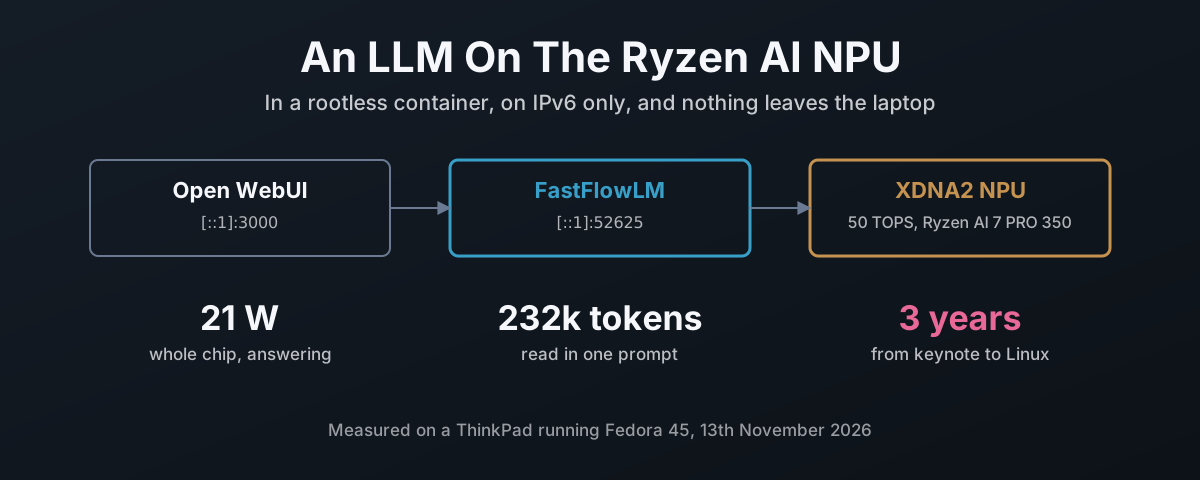
Running An LLM On The Ryzen AI NPU, In A Container
The NPU in a Ryzen AI laptop is 50 TOPS that sits idle on most Linux installs. This walks through building AMD’s amdxdna driver and keeping only the kernel module on the host, building FastFlowLM with AMD’s XRT runtime into a rootless podman container matched to that driver, binding everything to IPv6 loopback and starting it at boot with Quadlet. Then what it does: nine models benchmarked, a 232,000-token context test, Whisper speech-to-text at ten times real time, Open WebUI and the 7,000 hidden tokens it was adding to every message, and the speed and energy of the NPU measured against llama.cpp on the Radeon 860M iGPU. Last, the timeline: three years from AMD announcing Ryzen AI to a language model on its NPU under Linux, delivered by a project AMD did not start, while the effort went to Copilot+ on the Fisher-Price OS (Windows) instead of the data centre and the Linux tooling AI professionals actually use.
Sorting TSC When Your Firmware Is Broken
On every boot for four months my ThinkPad E595 handed Linux one CPU core three seconds behind the other seven, and the kernel dropped the TSC for HPET. What the warning means, why an AMD Zen machine has no way to repair it from inside Linux, what 40 boots of journal say about the firmware, why tsc=reliable is the wrong answer, and how tscsync measures and moves the counters in UEFI before the kernel ever sees them, including the one core it marked BAD that Linux accepted anyway. Updated for BIOS 1.30: it does not fix the offset, and the kernel’s clocksource watchdog dropped the TSC on two boots even after tscsync synced the cores. With tsc=nowatchdog it held, and a five-minute check against the real-time clock, source included, found no warps and no drift. Last, what the fallback does on any KVM hypervisor, Proxmox or not: the master clock goes, guests lose their fast clock read, and on this laptop a guest clock read came out seven times slower.
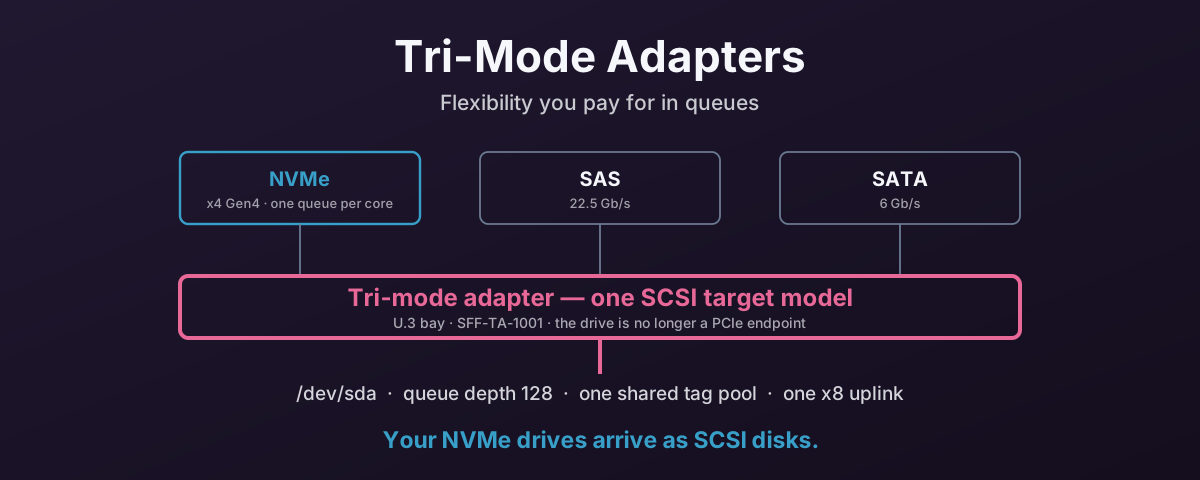
Tri-Mode Adapters Buy Flexibility With Your NVMe Queues
A tri-mode adapter lets any bay take SAS, SATA or NVMe — real flexibility, and the reason U.3 backplanes exist. What it does not advertise is that your NVMe drives stop being NVMe drives: they arrive in Linux as SCSI disks on mpt3sas, queue depth 128, sharing one tag pool and one x8 uplink. Two Gen4 drives saturate the card. A single Gen5 drive is already past it. Whether that trade still makes sense in 2026, and why the universal bays belong to the backplane rather than the controller.